Saturday, December 30, 2006

Hillary falls to earth in poll race

By Tony Allen-Miller for the London Times:

The first vote is still more than a year away, but the campaign to replace President George W. Bush in the White House is already throwing up surprises.

Unfortunately for Senator Hillary Clinton, long the front-runner in the Democratic drive to retake the presidency, most of them are coming at her expense.

A brace of Christmas opinion polls has left Clinton with a political hangover after a year that had appeared to cement her status as the Democrats’ best-organised, best-financed and best-connected contender for her party’s presidential nomination.

Despite winning re-election to the US Senate by a handsome margin in mid-term voting last month, Clinton has had little to celebrate as polls from the presidential primary battlegrounds signalled early trouble for her historic bid to become America’s first woman president.

In Iowa, the Midwestern state that will once again open the primary season with its caucus votes on January 14, 2008, Clinton slumped to fourth place with only 10% of the vote in a survey of 600 likely Democratic voters.

In New Hampshire, which will hold the first full primary eight days later, Clinton had appeared to be cruising comfortably with a 23-point lead over her Democrat rivals — until last weekend, when a poll in the Concord Monitor newspaper showed her only one point ahead of Senator Barack Obama, the comparative political newcomer who is considering a similarly historic attempt to become America’s first black president.

Obama’s emergence as a charismatic alternative to the Democratic party’s veteran leadership — and the arrival in the race last week of former Senator John Edwards, the losing vice-presidential candidate in 2004 — have electrified Washington and placed Clinton under early pressure to abandon her cautious approach to the presidency and take to the hustings months earlier than she might have planned.

Several Democratic strategists last week urged Clinton to unleash a “charisma offensive” in the new year to counter the saturated media coverage that has helped propel Obama up the polls.

Clinton has been virtually invisible as first Obama and then Edwards — who launched his second presidential bid on Thursday in the back garden of a New Orleans house ruined by Hurricane Katrina — have been grabbing campaign headlines.

Last week’s Iowa poll showed Obama and Edwards tied for the primary lead with 22% each.

Clinton supporters argued that their candidate’s poor showing — she was also beaten by Tom Vilsack, the Iowa governor who is considering his own bid for the White House — reflected the fact that she was focused on her Senate re-election in New York and did not visit Iowa this year.

Yet Obama hasn’t visited Iowa either, and the same poll found that both Obama and Edwards would perform better than Clinton against the likely frontrunners for the Republican nomination — former New York mayor Rudolph Giuliani and Senator John McCain of Arizona.

“She’s in a quandary right now,” acknowledged Ray Strother, a longtime Democratic political consultant.

“She doesn’t need to start a war of any kind, but I don’t think she knows how to handle [Obama],” Strother said. “I think they’re preoccupied with it right now.”

Neither Clinton nor Obama has formally declared that they will be candidates, but Obama, the son of a black Kenyan father and a white mother from Kansas, is widely expected to confirm his intentions after spending Christmas in Hawaii discussing the contest with his family.

Before leaving home in Chicago, Obama and his wife Michelle attended a meeting with advisers who presented a campaign simulation complete with mock travel schedules to illustrate the gruelling demands of the race.

Michelle Obama had previously expressed concern that her husband might be vulnerable to a racist assassination attempt, but local reports suggest she has been reassured by secret service briefings on how the 45-year-old senator would be protected.

Clinton, meanwhile, needs no reminder of the perils of the presidency. As the first former first lady to run for the White House, she is not only a battle-hardened campaigner, but she counts among her advisers arguably the shrewdest political strategist in America — her husband, former president Bill Clinton.

Few presidents have been as adept as Clinton at charming ordinary voters, but opinion polls have repeatedly indicated that much of America regards Hillary as cold, calculating, strident and ideological.

In one Gallup poll last month 13% said they disliked her 9% said she was riding her husband’s coat-tails and 6% called her dishonest.

Both Democrats and Republicans who have worked with the senator in Washington say those negative ratings are unfair, but the challenge for Hillary is to persuade voters — especially in Iowa and New Hampshire — that she can be as warm and likeable as her husband.

“People need to get to know her,” said Doug Hattaway, a Washington strategist.

He said he would advise Clinton: “Forget the press. Forget the politics. Talk to the voters. There’s no substitute for getting on the ground and interacting with people”.

For the other contenders who are hovering at the margins of the race, the main hope is that Democratic voters will prove reluctant to make the unprecedented choice of either a black or a woman in a year when so important an opportunity beckons and Republicans may be vulnerable because of opposition to the war in Iraq. Edwards has already staked out his claim to be the leading white male contender should either Clinton or Obama stumble.

Senator Joseph Biden, who will assume the chairmanship of the Senate’s foreign affairs committee, may throw in his hat as a possible vice-presidential choice.

There is a vociferous group of liberal Democrats who hope that former vice-president Al Gore can be persuaded to avenge his loss to Bush in 2000.

Even Senator John Kerry, the defeated candidate in 2004, is muttering about a second attempt, although few Democrats appear to be encouraging him.

For now, though, the battle is between Obama and Clinton, neither of whom are likely to wait long before paying their first campaign visits to Iowa.

AddThis Social Bookmark Button

Draft Obama movement pushes into Iowa

By Ed Tibbets for the Quad-City Times - Davenport, IA

The volunteer group urging U.S. Sen. Barack Obama, D-Ill., to run for president has purchased time in Des Moines for a television ad aimed at urging Iowans to encourage an Obama bid.

DraftObama.org, a Maryland-based group with members across the country, announced Friday that it has made a “modest” television advertisement buy in Des Moines.

The ad, called “Believe Again,” has already aired in New Hampshire and Hawaii, where Obama and his family have been vacationing. It also can be seen on the group’s Web site and on the video sharing site, YouTube.

Obama is expected to announce a decision about a bid next month.

Kris Schultz, a spokeswoman for the group, noted Iowa’s first-in-the-nation caucuses and said it has hundreds of supporters in Iowa. The group says it isn’t affiliated with Obama.

The ad will run New Year’s Day.

“We thought it would be a great way to start the new year,” Schultz said.

She said the volunteer group is “carefully targeting” its resources, but it could expand outside Des Moines later.

Obama, if he runs, will join a growing field of Democrats seeking the party’s nomination.

Already, Iowa Gov. Tom Vilsack, 2004 vice presidential candidate John Edwards and U.S. Rep. Dennis Kucinich, D-Ohio, have formally said they will run.

Obama and Sen. Hillary Rodham Clinton, D-New York, tend to lead early nationwide preference polls.

Recent surveys in Iowa have said Obama’s strength here is growing.
AddThis Social Bookmark Button

Thursday, December 28, 2006

Escalation Is Not The Answer

By Barack Obama for barackobama.com

As the New Year approaches, we are told that the President is considering the deployment of tens of thousands of additional troops to Iraq in the desperate hope of subduing the burgeoning civil war there.

This is a chilling prospect that threatens to compound the tragic mistakes he has already made over the last four years.

In 2002, I strongly opposed the invasion of Iraq because I felt it was an ill-conceived venture which I warned would "require a U.S. occupation of undetermined length, at undermined cost, with undetermined consequences." I said then that an invasion without strong international support could drain our military, distract us from the war with al-Qaeda in Afghanistan and further destabilize the Middle East.

Sadly, all of those concerns have been borne out.

Today, nearly three thousand brave young Americans are dead, and tens of thousands more have been wounded. Rather than welcomed "liberators," our troops have become targets of the exploding sectarian violence in Iraq. Our military has been strained to the limits. The cost to American taxpayers is approaching $400 billion.

Now we are faced with a quagmire to which there are no good answers. But the one that makes very little sense is to put tens of thousands more young Americans in harm's way without changing a strategy that has failed by almost every imaginable account.

In escalating this war with a so-called "surge" of troops, the President would be overriding the expressed concerns of Generals on the ground, Secretary Powell, the bipartisan Iraq Study Group and the American people. Colin Powell has said that placing more troops in the crossfire of a civil war simply will not work. General John Abizaid, our top commander in the Middle East, said just last month that, "I believe that more American forces prevent the Iraqis from doing more, from taking more responsibility for their own future." Even the Joint Chiefs of Staff have expressed concern, saying that a surge in troop levels "could lead to more attacks by al-Qaeda" and "provide more targets for Sunni insurgents." Once again, the President is defying good counsel and common sense.

As I said more than a month ago, while some have proposed escalating this war by adding thousands of more troops, there is little reason to believe that this will achieve these results either. It's not clear that these troop levels are sustainable for a significant period of time, and according to our commanders on the ground, adding American forces will only relieve the Iraqis from doing more on their own. Moreover, without a coherent strategy or better cooperation from the Iraqis, we would only be putting more of our soldiers in the crossfire of a civil war.

There is no military solution to this war. Our troops can help suppress the violence, but they cannot solve its root causes. And all the troops in the world won't be able to force Shia, Sunni, and Kurd to sit down at a table, resolve their differences, and forge a lasting peace. In fact, adding more troops will only push this political settlement further and further into the future, as it tells the Iraqis that no matter how much of a mess they make, the American military will always be there to clean it up.

That is why I believe we must begin a phased redeployment of American troops to signal to the government and people of Iraq, and others who have a stake in stabilizing the country - that ours is not an open-ended commitment. They must step up. The status quo cannot hold.

In November, the American people sent a resounding message of change to the President. But apparently that message wasn't clear enough.

I urge all Americans who share my grave concerns over this looming decision to call, write or email the President, and make your voices heard. I urge you to tell them that our soldiers are not numbers to add just because someone couldn't think of a better idea, they are our sons and daughters, our brothers and sisters, our neighbors and friends who are willing to wave goodbye to everything they've ever known just for the chance to serve their country. Our men and women in uniform are doing a terrific job under extremely difficult conditions. But our government has failed them so many times over the last few years, and we simply cannot afford to do it again. We must not multiply the mistakes of yesterday, we must end them today.

AddThis Social Bookmark Button

Barack Obama will give us all the Audacity of Hope

Recently, I've been reading a lot of editorials about Obama being "exotic" but empty. As someone who is currently reading Obama's, "The Audacity of Hope", I can attest that the Illinois Senator is anything but empty. Take, for instance, this passage from the book's prologue:
I suspect that some readers may find my presentation of these issues to be insufficiently balanced. To this accusation, I stand guilty as charged. I am a Democrat, after all; my views on most topics correspond more closely to the editorial pages of the New York Times than those of the Wall Street Journal. I am angry about policies that consistently favor the wealthy and powerful over average Americans, and insist that government has and important role in opening up opportunity to all. I believe in evolution, scientific inquiry, and global warming; I believe in free speech, whether politically correct or politically incorrect, and I am suspicious of using government to impose anybody's religious beliefs - including my own - on nonbelievers. Furthermore, I am a prisoner of my own biography: I can't help but view the American experience through the lens of a black man of mixed heritage, forever mindful of how generations of people who looked like me were subjugated and stigmatized, and the subtle and not so subtle ways that race and class can shape our lives.

But that is not all that I am. I also think my party can be smug detached, and dogmatic at times. I believe in the free market, competition, and entrepreneurship, and think no small number of government programs don't work as advertised. I wish the country had fewer lawyers and more engineers. I think America has more often been a force for good than for ill in the world; I carry few illusions about our enemies, and revere the courage and competence of our military. I reject a politics that is based solely on racial identity, gender identity, sexual orientation, or victimhood generally. I think much of what ails the inner city involves a breakdown in culture that will not be cured by money alone, and that our values and spiritual life matter at least as our GDP.
I would suggest that anyone who has any doubts about the intelligence and full being of Barack Hussein Obama read this book. You'll find that there isn't enough room left in the man for any emptiness!

As long as I am dispelling this argument against Obama, let me continue with a little bit of background for the presumed candidate.

Unlike previous candidates who shied away from their early indiscretions, Obama has embraced them as examples of the struggles and confusions of a teenage boy - he said, "teenage boys are frequently confused". Where Bill Clinton admitted to smoking marijuana but claimed he "didn't inhale", Obama said on "The Tonight Show with Jay Leno", "I inhaled - isn't that the point?".

Obama studied for two years at Occidental College in California, transferred to Columbia College - where he majored in political science with a specialization in international relations. After graduation, he worked for a non-profit organization that helped local Chicago churches organize job training programs for residents of poor neighborhoods. He then went to the Harvard School of Law where he was elected president of the Harvard Law Review and obtained his Juris Doctor degree magna cum laude.

Returning to Chicago, he passed the Illinois Bar exam and went to work for the civil rights law firm of Miner, Barnhill & Galland. He also taught constitutional law at the the University of Chicago Law School, a position he continued even after being elected to represent Chicago's 13th District in the Illinois State Senate. He didn't give up his teaching position until he was elected to the US Senate in 2004.

Once Barack Obama makes an offical announcement of his intention to get the Democratic nomination for President of the united States, he will have my full backing. 'nuff said!
AddThis Social Bookmark Button

Obama will make the new year interesting

By Dan K. Thomasson for Capitol Hill Blue

While the New Year can be expected to bring a series of major announcements about who will or won't run for the presidency, none is more anticipated than a decision from Illinois Sen. Barack Obama. The political world has been abuzz for weeks at the prospect of an African-American making a serious run at the Democratic nomination and the question of race seems thankfully to be far less a concern than Obama's relative inexperience in both foreign and domestic policy.

Whether this nation is finally grown up enough to accept the possibility of a black becoming president, this much is certain: For the first time, the prospective candidate, if he decides to push ahead, will be coming not from the arena of civil rights and protest but from a position that is on an equal footing with the other potential nominees, a high elected office. Until now the African-American candidates -- there have been several, but the Rev. Jesse Jackson and the Rev. Al Sharpton come quickest to mind -- have approached the task from almost an adversarial position with the white segment of the electorate.

That is not a place the iconic Rev. Martin Luther King thought would be the most advantageous for African-Americans. He understood that only if the black candidate was equal in political (elected) stature as the rest of the field and was broadly appealing to whites as well as to blacks would there be an opportunity to sublimate race and successfully break the color barrier to the Oval Office.

Obama most definitely fits part of that profile. He is a handsome U.S. senator with a first-rate mind and a quick wit. He is not given to the fire-and-brimstone racial rhetoric of the old days. In the last election, he was among the most popular and tireless workers for white Democratic candidates as well as for black candidates. He is considered the one black candidate who could overcome the built-in racial negative factor that has plagued other African-American candidates.

What he lacks is the tenure and experience in national office, particularly in foreign policy, that many voters believe is necessary in a world that is increasingly tumultuous, both politically and economically. The honor of having the first African-American elected to the presidency probably should have gone to the Republicans, who tried unsuccessfully to convince former Secretary of State Colin Powell to run several times. Powell matches Obama's charisma, but adds unparalleled military and foreign-policy experience to the mix. But he has shown no interest in seeking the office.

Obama brings more excitement to the early speculation than any other candidate with the exception of Sen. Hillary Rodham Clinton of New York. He says he will make a decision next month, as will Clinton. She already has a strong campaign chest, leads him in the early polls and has an organization geared up waiting for the word. She also has the advantage of being married to one of the best campaigners in the 20th century.

Veteran observers believe that Obama will run on the theory that even if he loses the nomination, he will have gained valuable experience. They also contend that the chances for electing a Democrat may never be better considering the growing unpopularity of President Bush and the Republicans and that to wait another eight years would be tempting political fate. His time, they believe, is now and the fact that he seems to lack the seasoning and experience can be overcome by his proven campaign skills. His advisers are telling him it would not take them long to gin up a competitive campaign organization to match that of Clinton, whom they argue is hindered by a negative factor as large as, if not larger than, his -- the "she can't win" stigma.

Then there is, as always, the vice-presidential question. Even if Obama cannot win the top spot on the ballot but shows good strength, he would position himself as the possible running mate of whomever does. Serving a term or two as vice president, his supporters believe, would give him a leg up for the presidency. While that strategy has succeeded in the past -- Lyndon Johnson, Richard Nixon and George H.W. Bush, for instance -- it is not always the sure bet it might seem. But then, no one runs for the vice-presidential nomination.

Whatever Obama decides, the very fact that he is considered a viable contender in only the third presidential election in the new millennium is refreshing and long overdue. The next few weeks should be interesting.

AddThis Social Bookmark Button

The race is now between Obama and Edwards?

By Deborah White for About.com

Merry Christmas, Democrats!

I believe Santa has brought us exactly what we've been wishing for: the beginnings of a competitive, two-horse race for 2008 between interesting, bona fide liberals, both with positive messages of hope and healing for our great nation.

Yesterday, KCCI-TV in Des Moines, Iowa released the results of an exclusive, Survey2000 poll, which asked Iowans about their choices for the Iowa Caucus, set for January 14, 2008. The survey was conducted from December 18-20, and has a margin of error of no more than plus or minus 4 percentage points.

And I'm not surprised that the overall Democratic results were:

John Edwards 22%
Barack Obama 22%
Tom Vilsack 12%
Hillary Clinton 10%
Al Gore 7%
John Kerry 5%
Wesley Clark 4%
Dennis Kucinich 4%
Joe Biden 1%
Evan Bayh 1%
Bill Richardson 1%
Undecided 11%

No surprise that Sen. Hillary Clinton fares poorly in Iowa. As I've preached many times, middle-class America is deeply uncomfortable with her. Also, Hillary carries a back-breaking load of political baggage from the past two decades.

John Kerry, Hillary Clinton and, to my sadness, Al Gore, are viewed by many voters under 40 as yesterday's news.... political ghosts from past decades. These Iowa polls results reflect that reality.

In contrast, Edwards and Obama both have built fresh, positive images, and enjoy strong support on the college campus circuit.

The Only Surprises
The only surprises in these numbers are that both Tom Vilsack, Governor of Iowa, and John Edwards, who's been campaigning in Iowa for more than a year, didn't fare far better against Sen. Barack Obama, who surprised the nation just 3 months ago when he admitted to considering a 2008 run for the White House.

Tom Vilsack, of course, isn't a serious 2008 presidential candidate, as he's a virtual unknown outside home state Iowa. I saw him last week on The Daily Show. Vilsack's a likeable enough guy, and seems bright and informed. I assume he's either running for the 2008 vice-presidency, or to garner national exposure for future races.

Edwards vs. Obama
Today, I believe that nationally, the two leading candidates for 2008 Democratic nomination for the presidency are Sen. Barack Obama and former Sen. John Edwards.

While both are liberals, they have clear differences. They stake out different ideological portions of the Democratic Party... Edwards being more liberal than Obama... but with substantial overlap. I'll dissect these differences in great detail in 2007.

Conditions can change, though, and a year in politics is a very, very long time.

For instance, if the U.S. suffered another 9/11 style attack in 2007-08, Democrats may opt for a candidate with superlative national security credentials and a more moderate Iraq War stance: Sen. Hillary Rodham Clinton or retired U.S. Army General Wesley Clark come to mind.

But given the political, security and economic climate in December 2006, this results of this poll absolutely do NOT surprise me. The frontrunners now are Edwards and Obama.

Of those two, who would I vote for? I don't know. I have a lot yet to learn about both, and I have no serious objections to either.

So Merry Christmas, Democrats!

With the Democratic-controlled Congress taking office in less than 2 weeks, and several stellar Democratic potentials in the 2008 race for the White House, I can only surmise that Santa included us on his 2006 "Good List."

Ho, ho, ho, indeed!

AddThis Social Bookmark Button

Tuesday, December 26, 2006

Obama Shapes an Agenda Beyond Iraq War

By Josh Gerstein for the New York Sun

Senator Obama's early opposition to the war in Iraq is the best known of his views, but voters taking his measure as a potential president will discover that he is a leader in securing stray weapons from the former Soviet Union, a key backer of American aid to the Congo, and that he would tend to support a missile strike on Iran if other methods fail to get Tehran to abandon its nuclear program.

In most respects, the Illinois Democrat's positions on foreign affairs are more fleshed out than one might expect for a leader concluding his second year in the Senate, though they lack the breadth and detail set forth by some of his colleagues who have spent decades in the public eye.

When he took office in 2005,Mr. Obama became the most junior Democrat on the Senate Foreign Relations Committee. However, the issues section of his Senate Web site, which lists his views on crime and aid to senior citizens, gives few details of his thoughts on America's role abroad.

Mr. Obama's foreign policy positions, gleaned from his speeches and writings, are squarely in the Democratic Party mainstream, though he often goes out of his way to distance himself from some on the left who downplay the dangers facing America. His statements and associations in foreign policy circles also suggest he might, as president, be more willing to use force to intervene in humanitarian crises than other presidents have. It seems certain he would make promotion of human rights a more serious factor in American diplomacy. He would also be likely to impose stricter rules on CIA interrogators — rules that some argue could hamper intelligence gathering and ultimately cost American lives.

In his new, best-selling book, "The Audacity of Hope," Mr. Obama devotes a 53-page chapter to international issues. In one passage, he scolds self-described liberals for saying in a poll last year that their top foreign policy concerns were "withdrawing troops from Iraq, stopping the spread of AIDS, and working more closely with our allies."

"The objectives favored by liberals have merit. But they hardly constitute a coherent national security policy," Mr. Obama declares. Alluding to the Vietnam War, he says, "It's useful to remind ourselves, then, that Osama bin Laden is not Ho Chi Minh, and that the threats facing the United States are real, multiple, and potentially devastating."

On Iraq, Mr. Obama has been calling for more than a year for a "phased redeployment" of American troops. He also favors a conference of regional powers, including Iran and Syria, to discuss Iraq's future. He has shied away from rigid deadlines and has even spoken of keeping American troops in Iraq if Iraqis can settle their differences. "He's been very thoughtful and judicious about what our stakes are in the conflict," a State Department and National Security Council official under President Clinton, Susan Rice, said. "He basically presaged the Iraq Study Group's comments."

Mr. Obama has also taken pains to make clear that he is not a pacifist. "I am not opposed to all wars. I'm opposed to dumb wars," he said at an anti-war rally in 2002. "What I am opposed to is the cynical attempt by Richard Perle and Paul Wolfowitz and other armchair, weekend warriors in this administration to shove their own ideological agendas down our throats, irrespective of the costs in lives lost and in hardships borne."

Like other Democrats, Mr. Obama has faulted the Bush administration for not pushing harder for peace between Israel and the Palestinian Arabs. The senator has also been publicly supportive of Israel and enjoys significant support in the Jewish community in Illinois. "He has long-standing position papers going back early into his Senate campaign which have been very strong on the defense of a safe and secure Israel," a Chicago lawyer who traveled with Mr. Obama in Israel in January, Alan Solow, said.

READ MORE

AddThis Social Bookmark Button

Monday, December 25, 2006

Obama campaign headquarters to be in Chicago?

By Lynn Sweet for the Chicago Sun-Times

Watch for Sen. Barack Obama to headquarter his anticipated 2008 presidential campaign in Chicago - and leverage that to the hilt in the critical first vote in neighboring Iowa.

Locating his political operation in Chicago will let his campaign mobilize thousands of lllinois Democrats to help in Iowa.

The 2008 Democratic calendar is not finalized; many states want to hold early primaries to influence the selection of the nominee and erode the power of Iowa and New Hampshire in the selection process.

Still, the basic outlines are in place. Iowa and New Hampshire - states traditionally crucial because they were the first votes - will be joined in January 2008 by Nevada and South Carolina.

Obama, on vacation in Hawaii, has decided to run. He has said he will announce his decision in January.

Under the tentative new schedule, the Iowa caucus will be Jan. 14, followed by Nevada on Jan. 19, New Hampshire on Jan. 22 and South Carolina on Jan. 29.

Presidential contenders, however, ignore Iowa and New Hampshire at their peril in 2008. That's why former Sen. John Edwards (D-N.C.), who will announce his presidential bid -- his second - this week from New Orleans, has been making regular pilgrimages to Iowa. And that's why Obama did some barnstorming in New Hampshire on Dec. 10.

Three-way Iowa race

It has been ages since Sen. Hillary Rodham Clinton (D-N.Y.) has been to either Iowa or New Hampshire, and a new poll shows that Clinton, nationally the front-runner, faces an Iowa fight.

While much of the 2008 Democratic presidential storyline so far portrays the contest as increasingly a two-person race, Edwards is a strong factor in Iowa, where Clinton support is slipping.

A poll of likely Iowa voters shows a dead heat - 22 percent each - between Edwards and Obama for the 2008 caucuses. Iowa Gov. Tom Vilsack, another White House contender and obviously well-known in the state, came in at 12 percent, with Clinton at 10 percent.

The poll of 600 likely voters could swing four points either way.

Obama's N.H. surge

A new poll by the Concord Monitor taken last week showed that Obama's New Hampshire visit - which generated massive coverage in the state - had an impact.

Granite State Democrats put Obama in a statistical tie with Clinton. That's a switch from a poll last month by the newspaper in which Obama was behind by 23 points.

AddThis Social Bookmark Button

Polls show Obama having a better time against Republicans than Hillary Clinton

From the Time Magazine Blog of Tom Bevan:

On the heels of the new poll in Iowa earlier this week showing Barack Obama tied with John Edwards atop the Dem field and Hillary plummeting to fourth place with 10%, Research 2000 has another 2008 poll out this morning for New Hampshire, conducted for the Concord Monitor from December 18 through December 20, 2006.

On the Dem side, Obama has leapt into a statistical dead heat with Hillary. For the GOP, Giuliani and McCain are neck and neck:

Democrats
Hillary Clinton 22%
Barack Obama 21%
John Edwards 16%
Al Gore 10%
John Kerry 7%
Wesley Clark 4%
Dennis Kucinich 4%
Joe Biden 2%
Tom Vilsack 2%
Evan Bayh2%
Bill Richardson 2%
Undecided 8%

Republicans
Rudy Giuliani 26%
John McCain 25%
Mitt Romney 10%
Newt Gingrich 8%
Condi Rice 6%
George Pataki 3%
Jeb Bush 1%
George Allen 1%
Sam Brownback 1%
Rick Santorum 1%
Duncan Hunter 0%
Undecided 18%

At first blush the horserace numbers don't look too terrible for Hillary - and certainly much better than they did in Iowa. I suppose Hillary's numbers could have been worse, especially if you remember the Boston Herald story from early August reporting on the animosity New Hampshire Dems had toward Hillary, calling her names like a "shrew" and an "evil, power-mad witch."

But, as in Iowa, the real problem for Clinton in the New Hampshire poll is in the hypothetical head to head matchups. Here they are:

Obama 47, McCain 43
Obama 46, Giuliani 39
Obama 48, Romney 29

Edwards 44, McCain 44
Edwards 41, Giuliani 40
Edwards 46, Romney 30

Giuliani 42, Clinton 38
Giuliani 39, Kerry 37
Giuliani 40, Gore 37

McCain 46, Clinton 43
McCain 45, Kerry 40
McCain 46, Gore 39

Clinton 45, Romney 31
Kerry 40, Romney 32
Gore 38, Romney 32

Just like in Iowa, Hillary loses to Rudy and McCain but beats Romney. And just like in Iowa, Obama beats them all. Edwards doesn't run as strong in New Hampshire as in Iowa - no surprise there - but he still manages a dead heat against McCain and Giuliani and handily beats Romney. So even though Hillary is clinging to a lead at the top of the field, she's once again giving off the "unelectable" vibe in comparison to her two most serious primary challengers.

AddThis Social Bookmark Button

What's in a name?

The uproar of Barack Obama's middle name notwithstanding, I thought I would look into the origins of his name and this is what I came up with.

Barack - It could be a Jewish name, a derivitive of the name Barak which means "lightning" in Hebrew. This was the name of a military commander in the Old Testament. It can also come from Baraka, which is Arabic for "blessed".

Hussein - Pet form of Hasan. Hussein ibn Ali (also called Al-Hussein) was the son of Ali and the grandson of the Prophet Muhammad. Al-Hasan was his older brother. The massacre of Husayn and his family caused the split between Shiite and Sunni Muslims, which continues to this day.
AddThis Social Bookmark Button

Obama and Clinton making it tougher for other Demo candidates

By Dan Balz, Washington Post

WASHINGTON -- Senators Hillary Rodham Clinton of New York and Barack Obama of Illinois are already rewriting the script of the 2008 Democratic presidential campaign, driving potential Democratic rivals to the sidelines.

Trading on their star power, capacity to raise tens of millions of dollars with relative ease, and ability to dominate news media attention, the two senators are casting a huge shadow over all others who may run.

What once shaped up as a sizable field of Democratic candidates is now shrinking. Senator Evan Bayh, Democrat of Indiana, announced on Dec. 16 that he would not seek the Democratic nomination, a surprising decision that came just days after he had witnessed firsthand Obama's drawing power in New Hampshire.

As Bayh drew small crowds on his seventh trip to the Granite State earlier this month, Obama enjoyed sold-out audiences and saturation coverage on his first trip there.

Bayh became the third Democrat to quit the race before Clinton or Obama had taken formal steps to enter. Former Virginia Governor Mark R. Warner and Senator Russell Feingold of Wisconsin abandoned their bids after lengthy periods of exploration.

All chose not to run for their own reasons, but Obama's sudden emergence creates a significant obstacle to those hoping to become the alternative to Clinton, the front-runner in the Democratic nomination contest.

"Simply put, it's the Obama factor," said Democratic pollster Peter D. Hart.

"Candidates who used to do careful exploration with the hope that they could catch fire in Iowa and New Hampshire and move from there recognize that there's no oxygen left out there for their candidacies," Hart said.

Republicans have their own celebrity candidates in Senator John McCain of Arizona and former New York mayor Rudolph W. Giuliani, but they cast a far smaller shadow on their rivals.

Those so far sidelined in the GOP race -- Senators Bill Frist of Tennessee and George Allen of Virginia -- have landed there through their own mistakes, not the looming presence of the two early poll leaders.

Dominating candidates are not new to presidential campaigns, nor is it uncommon for some politicians to explore a candidacy but never run.

In 1992, many prominent Democrats chose not to run, fearful that President George H.W. Bush could not be defeated. In 2000, George W. Bush was the clear front-runner for his party's nomination, but the winnowing did not begin until late summer of 1999 -- nine months later than is happening this time.

Even though neither has announced for president, Clinton and Obama have demonstrated the advantages of celebrity status in a world of constant cable news and expanding Internet communities.

That culture serves to reinforce the advantages of celebrity, repeatedly focusing attention on the celebrities rather than paying close attention to the doggedness of dark horses -- at least until serious campaigning begins.

A poll released yesterday shows Obama running about even with Clinton among likely voters in the New Hampshire primary.

Among participants in the Concord Monitor poll, 22 percent said they would vote for Clinton if the primary was held now, and 21 percent said Obama. That put them slightly ahead of former Senator John Edwards of North Carolina, with 16 percent.

At this point, Clinton and Obama are eclipsing a group of Democratic heavyweights that includes the party's presidential and vice presidential nominees in 2004, Senator John F. Kerry of Massachusetts and Edwards.

They also are leading other senators and governors, including senators Joseph Biden of Delaware and Christopher Dodd of Connecticut and governors Bill Richardson of New Mexico and Tom Vilsack of Iowa.

Edwards plans to launch his campaign this week. The others are still weighing when or whether to jump in.

Bayh saw his opening to run after the Democratic Party's losses in 2004. He presented himself as a Democrat who could win Republican states, such as his home state of Indiana.

But after the Democrats' victories last month, Bayh's advisers found that his potential in red states was less appealing to Democratic activists looking toward 2008.

Vilsack concluded there is still room for a dark horse. He also is hoping to ignite his candidacy on his home turf -- in the Iowa caucuses.

William Mayer, a political science professor at Northeastern University who has written extensively about the nominating process, said Clinton and Obama both appeal to Democrats on a symbolic level.

"The Democrats would dearly love to elect the first woman or black president," he said. "Given that, it's going to be tough to run an insurgent campaign against these people."
AddThis Social Bookmark Button

Sunday, December 24, 2006

Obama pulls even with Clinton in New Hampshire

From the Associated Press.

CONCORD, N.H. --Two weeks Sen. Barack Obama's first trip to New Hampshire, a new poll shows him about even with Sen. Hillary Clinton among likely voters in the state's 2008 Democratic presidential primary.

Among participants in the Concord Monitor poll, 22 percent said they would vote for Clinton if the primary was held now, and 21 percent said Obama. That put them slightly ahead of former North Carolina Sen. John Edwards, who was at 16 percent.

Last month, a Monitor poll showed Clinton leading Obama by 23 percentage points.

"I'm not surprised because Barack Obama got five days of constant media attention in New Hampshire," said Jim Demers, a Democratic activist who accompanied Obama throughout his visit. "Obama has demonstrated to the people of New Hampshire that he's a top tier candidate."

On the Republican side, former New York Mayor Rudy Giuliani and Arizona Sen. John McCain are about even, with Giuliani at 26 percent and McCain at 25 percent. Massachusetts Gov. Mitt Romney is next with 10 percent.

The telephone poll of 600 likely voters was conducted Monday through Wednesday by Maryland-based Research 2000 and had a sampling margin of error of plus or minus 4 percentage. The likely voters for the Democratic and Republican primary totaled 400 respondents each. For those questions, the margin of error was plus or minus 5 percentage points.

In hypothetical general election matchups, Giuliani has a slight lead over Clinton, while Clinton and McCain are about even. Obama is slightly ahead of both Giuliani and McCain. Edwards is tied with McCain and about even with Giuliani.

"There are a lot of independents. These are the same people who loathe Bush, loathe the Iraq war," said Del Ali, president of Research 2000. "But deep down, they don't like Hillary Clinton."

The numbers don't mean much roughly a year before the primary, some experts cautioned. President Bush, for example, held a double-digit lead over McCain in a New Hampshire poll nine months before the 2000 primary.

"You will have this tremendous amount of energy and motion to secure the allegiance of about 5,000 people," said Charlie Arlinghaus, president of the Josiah Bartlett Center for Public Policy. "And nobody else is going to start paying attention until after the summer."

AddThis Social Bookmark Button

Saturday, December 23, 2006

A rose by any other name

Have you ever seen anyone on the talk show circuits - or in print - refer to a certain Republican Senator/presidential contender as John Sidney McCain III? What about Rudolph William Louis Giuliani III? Did you know that the former first lady's middle name was Diane? Hillary Diane Rodham Clinton. Yes, we've heard people use her maiden name along with the one she received when she married William Jefferson Clinton (nee William Jefferson Blythe III). Now there is one potential candidate out there that uses his middle name, that would be the Governor of Massachusetts, Mitt Romney. He uses his middle name all the time - it's his first name he never uses - of course, if my name was Willard Mitt Romney, I'd probably use my middle name too - even if it did sound like a piece of athletic equipment. Did you know that Dennis Kucinich's middle name was John? There's Thomas James Vilsack, William Blaine Richardson, Johnny Reid Edwards, John Forbes Kerry, Newton Leroy Gingrich, George Elmer Pataki, and Michael Rubens Bloomberg. Most of you didn't even know the full name of any of these candidates.

On the other hand, there is Barack Hussein Obama. Now, thanks to the Right Wing pundits and bloggers, Obama's middle name is well known to anyone who is following the race to the White House. The unfortunate part of this is that the Right is using it in an attempt to put an idea in the psyche of voters that, perhaps, Obama is an enemy of the state. This is of course a ridiculous notion.

These are the same people who keep saying that Obama doesn't stand for anything - another ridiculous statement. You cannot be a United States Senator and not leave some kind of record - either a voting record, or a record of bills introduced. These same people say Obama doesn't have any foreign relations experience - the fact that he specialized in International Relations while he was a Political Science major at Columbia University and has sat on the U.S. Senate Foreign Relations committee for the past two years must not count.

So, before you start spreading the name of Hussein, don't forget about Willard, Rubens, Blaine, Leroy, Sidney and Forbes. No, they're not foreign sounding, but they certainly are silly!

(cross posted on my other blog -
Left of Centrist)
AddThis Social Bookmark Button

Robert Novak says Obama is definitely running

According to columnist/CIA agent outer, Robert Novak's latest column, it appears all that remains for Obama to be in the race is an official announcement.
"Contrary to reports that Barack Obama is still trying to make up his mind whether to seek the 2008 Democratic presidential nomination, sources close to the first-term senator say he is unequivocally committed to making the race.

The word has spread through political circles that Obama's wife, Michelle, is resisting the campaign out of fear for her husband's physical safety as an African-American candidate for president. But an Obama insider dismissed that as a problem. 'We took care of that last summer,' he told this column.

A footnote: Obama advisers were surprised how much the prospect of his campaign has shaken front-running Sen. Hillary Rodham Clinton. For the first time, she has asserted that she would have voted against going to war in Iraq if she knew then what she knows now."

AddThis Social Bookmark Button

Friday, December 22, 2006

Obama's experience compares favorably with incumbent's

Editorial comment from the Tomah Journal - Tomah, WI

Senator Barack Obama (D-Ill.) traveled to New Hampshire to test the presidential waters, and the reaction of voters and pundits couldn’t have been more different.

Voters in New Hampshire liked the idea. Obama drew a crowd of 1,500 in Manchester last week, and one reporter described the event as a “rapturous reception ... drawing the kinds of crowds and news media attention usually reserved for a sitting president or a presidential nominee.”

The reaction of the commentators was more muted. The Wisconsin State Journal was typical:

“Obama, touted as a top candidate for the Democratic presidential nomination, may be charismatic, smart and oozing with optimism. But the freshman U.S. senator also is untested and sorely lacking in executive and foreign policy experience.”

Sorely lacking in experience? Compared to whom? George W. Bush had only six years as governor of Texas under his belt prior to his election as president in 2000 (Obama, if elected, will have served four years in the Senate). Before that, Bush had failed in the oil business and made $13 million from his part-ownership of a publicly subsidized major league baseball team.

Obama’s experience: A law degree from Harvard and the first African-American president of the Harvard Law Review. Lecturer of constitutional law at the University of Chicago Law School. A practicing attorney in Chicago. Seven years in the Illinois state Senate. And while he lacks conventional foreign policy experience, he lived abroad for an extended period as a child, which gives him a unique insight on America’s role in the world. It’s a background that’s arguably more substantive than Bush’s.

Experience counts, but so do qualities like intelligence, poise, decency and the ability to articulate a vision. The latter is especially important. When politicians of both parties swallowed the administration’s justification for the Iraq War, here’s what Obama said in 2002:

“I don’t oppose all wars. What I am opposed to is a dumb war. What I am opposed to is a rash war. What I am opposed to is the cynical attempt by Richard Perle and Paul Wolfowitz and other armchair, weekend warriors in this administration to shove their own ideological agendas down our throats, irrespective of the costs in lives lost and in hardships borne.”

Who has been proven right -- the establishment men and women of Washington, D.C., or the upstart from Chicago?

This isn’t an endorsement of Obama; it’s possible that the rigors of a presidential campaign will unmask weaknesses in his personal and political character (that’s why campaigns are held). But pundits who believe presidential candidates must be marinated in years and years of high-profile elected offices are wrong. There may be reasons why Barack Obama shouldn't be president, but his relatively brief time on the national political stage isn’t one of them.
AddThis Social Bookmark Button

Birth of a political rock star

For those of you who missed it or would simply like to see it again. Here is Barack Obama's Keynote Speech at the 2004 Democratic Convention. This is where he first caught my eye - and the imagination of the rest of the nation.


Forget about the fact that he's endorsing John Kerry and listen to the mesmerizing oratory skills of a brilliant politician.


AddThis Social Bookmark Button

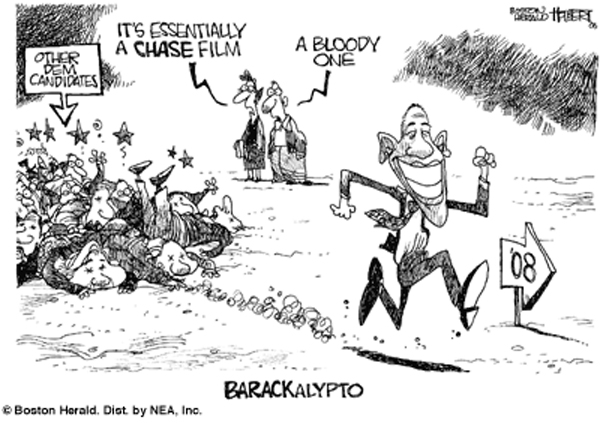
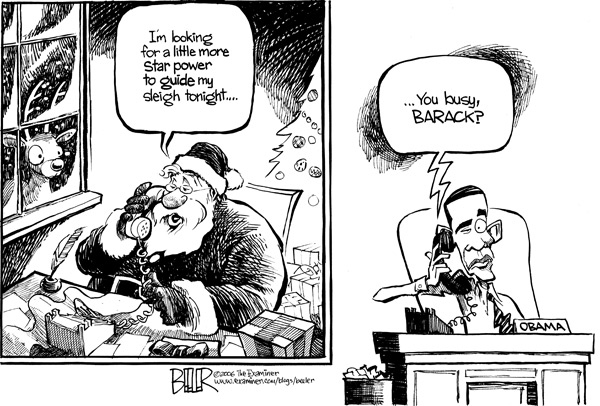
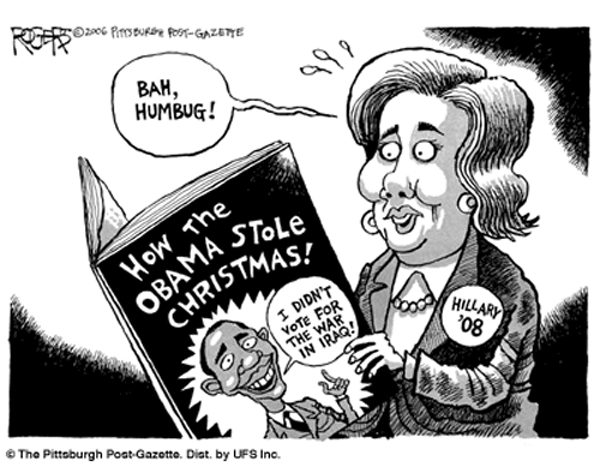
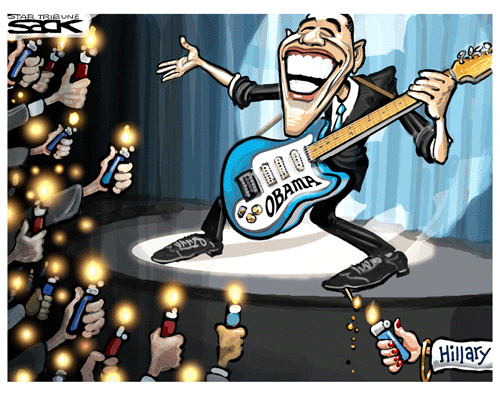
Editorial Cartoons featuring Obama - Vol. 2


AddThis Social Bookmark Button

Thursday, December 21, 2006

Obama who? Senator still unknown to many voters

He's been on Oprah, Letterman, Leno, "Monday Night Football'' and "The View.'' He's written two best-selling books and made the cover of Time and Newsweek magazines.

He's Barack ... who?

Some 33 percent of Americans say they have never heard of Illinois' Sen. Barack Obama, a likely presidential candidate in 2008, according to a new Gallup poll. Another 14 percent said his name sounded familiar but they didn't know enough about him to have an opinion.

Compare that to Sen. Hillary Rodham Clinton: Only 5 percent of those polled said they had no opinion of her - a double-edged sword, though, with 42 percent saying they know her and don't like her.

Gallup pollster Jeffrey M. Jones said freshman candidates usually have low recognition numbers but he was surprised at the Obama data given the senator's high-profile "political rock star" tag.

There are both negatives and positives in Obama's recognition numbers this early in the game, said John S. Jackson of the Paul Simon Public Policy Institute at Southern Illinois University.

"He has a way to go to get into the Hillary Clinton league'' in terms of recognition, Jackson said. On the other hand, "he can still define himself for that 47 percent'' - the 33 percent who don't know Obama from Adam and the 14 percent who said they don't know much about him.

Obama, vacationing in Hawaii for the holidays, will decide while there whether to seek the Democratic presidential nomination in 2008, his sister Maya Soetoro said this week.

Chicago Sun-Times
AddThis Social Bookmark Button

Obama Enjoys Islands During Holidays

From KITV Honolulu:

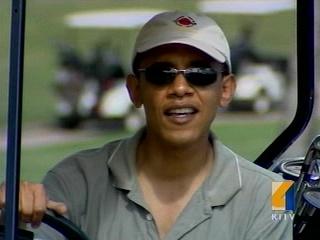
Sen. Barak Obama is spending the holidays in the islands. On Wednesday he was spotted on the links.The Punahou graduate was at the Olomana Links Golf Course with a group of friends on Wednesday. The Illinois senator grew up in the islands and still has family here.He played at the course on Sunday and had such a good time he returned for another round, sources said.

While in Hawaii he is expected to decide whether he wants to run for president in 2008.His half-sister said that Obama will make a decision in the next few days, then publicly announce it when he returns to Washington in early January
AddThis Social Bookmark Button

Edwards and Obama Tied in Iowa

From Taegan Goddard's Political Wire:

A new Research 2000 poll in Iowa shows John Edwards and Sen. Barack Obama tied among likely Democratic caucus voters with 22% each. Iowa Gov. Tom Vilsack trails with 12%, followed by Sen. Hillary Clinton at just 10%. All other potential candidates are in the single digits.

Among Republicans, Sen. John McCain leads with 27% followed by Rudy Giuliani at 26% and Mitt Romney at just 9%.
AddThis Social Bookmark Button

Obama the anti-Bush

Op-Ed from Michael Tomasky - Editor of The American Prospect

Should he or shouldn't he? Everyone, it seems, has an opinion about whether 2008 is the right time for Barack Obama to throw his Bears cap (famously donned during that "Monday Night Football" set piece) into the ring. Even in the unscientific realm of political punditry, rarely have assertions so plainly unprovable been delivered with such unyielding certitude.

He's too young; no, quite the contrary, he'll be too old if he waits. He needs more Senate experience, some legislation to his name; nonsense — years of service in the Senate are a negative, not a positive (just ask John Kerry). He doesn't stand for anything; pshaw — he stands for a great deal simply by being who he is.

All these claims have to do with Obama himself. But there is another factor, one that argues for an Obama candidacy that has nothing to do with Obama and everything to do with George W. Bush. I call it the Attraction of the Opposite.

The most reliable guide to presidential winners over the last quarter of a century is not ideology or charisma or any of the other established factors. It is instead what we might call character typology. That is, after four (or especially eight) years of one type of person, American voters tend to turn their affections toward someone who is that person's opposite — someone whose personality and affect provide a direct contrast to the fellow who's leaving office, who has something the other guy lacked.

Looking at the last four times the Oval Office has changed hands, it's quite easy to make the case that this was dramatically true in at least three cases.

In 1980, Jimmy Carter — serious, austere and full of warnings about the nation's crisis of confidence — gave way to the congenial optimism of Ronald Reagan.

In 1992, George H.W. Bush had come to be seen as remote, awkward and out of touch with the concerns of ordinary Americans. He yielded to that flesh-pressing natural and soulful feeler of pain, Bill Clinton.

By 2000, Clinton to many had become the reckless lothario who had sullied the nation's highest office. This was precisely why George W. Bush emphasized his sobriety, his piousness and his goal of restoring "honor and dignity" to the White House.

They fit the thesis like a glove. And even the race I've left out works pretty well. Yes, in some sense, Americans elected George H.W. Bush in 1988 to continue Reagan's policies. But Bush also strained to differentiate himself from Reagan. His "kinder, gentler America" and his "thousand points of light" were direct attempts to show voters that he recognized the ways in which Reagan was seen as having pursued heartless policies toward the poor and to signal that he would be different.

Which brings us to the present. George W. Bush, to most voters, is no longer the man who restored honor and dignity to the White House. Nor is he — in another line from his 2000 campaign — a "uniter, not a divider."

He is now instead the stubborn, highly partisan unilateralist who doesn't listen to others.

So what character type does this mean voters will be looking for in 2008? Someone who speaks of his frustration with our polarized politics and his fervent desire to transcend the red-blue divide.

Sound like anyone you know? I thought so.

If my theory is correct, then 2008, coming directly off of Bush's tenure, will be exactly the right time for Obama to run. His themes and his personality — his agreeable nature and penchant for self-contemplation, so utterly unlike the incumbent's petulant, unreflective swagger — will be uniquely in demand in 2008 in a way they just might not be in 2012 or 2016.

The only problem with my theory is this: Bush has revealed himself to be so deficient in so many regards that it's possible that several candidates can just choose a Bushian shortcoming and become its opposite.

For example, it's unlikely that New York Sen. Hillary Rodham Clinton, a woman about whom Americans are so divided, can plausibly run as the candidate who will transcend the red-blue divide. But she can exploit a different Bush personality trait by showing her intelligence, her command of the details of policy and her ability to speak in well-structured sentences that are clearly recognizable as the English language.

Arizona Sen. John McCain can exploit a third Bush weakness — that of having been a dreadful commander in chief — and present himself as something that he in fact is: a former soldier who knows the military and can be assumed to make decisions in what he believes to be its best interests. And so on.

So the Attraction of the Opposite could work in any of several ways in 2008. But Bush's greatest flaw to the greatest number of voters has to do with his unrelenting partisanship. And this greatest flaw plays right into Obama's greatest strength. He will have other opportunities to run, but it's highly unlikely that he'll ever again have an opportunity quite like this one.
AddThis Social Bookmark Button

Wednesday, December 20, 2006

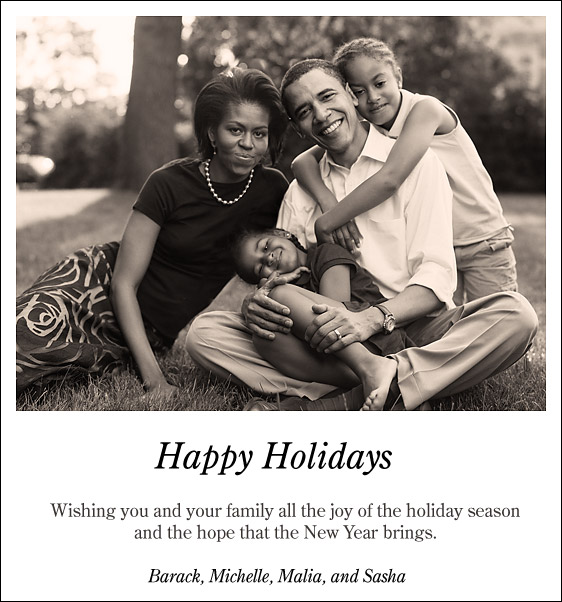
Happy Holidays!

I thought I would share a little something I just received in my email.
AddThis Social Bookmark Button

The swiftboating of Obama will soon be in full gear

One of the interesting aspects of the Republican party these days is to say things - I was being nice, I meant to say they LIE - about their opponents and then sit back and watch as the lie spreads. They obviously are well aware of the famous Samuel "Mark Twain" Clemens quote, "a lie can travel half way around the world while the truth is putting on its shoes." They will also use innuendo - in this case, Right Wingers have taken to use Obama's middle name "Hussein" when they talk about him in the hopes that people will associate Obama with Saddam.

Here in Fort Wayne, Republican Cogressman Mark Souder said during a radio interview that hisDemocratic opponent, Dr. Tom Hayhurst, was in favor of amnesty for illegal aliens. Not only had Dr. Hayhurst never said that, Souder had, himself, actually voted for amnesty FIVE times. These guys will stop at nothing. We must remain vigil.

One example of the lie spreading took place yesterday on FOX news when Fox political analyst Dick Morris said, "Because anybody who thinks about Obama for five minutes knows the guy's never introduced a bill. He's never been important. He's spent 100 weeks in the Senate. He's basically a - no foreign policy experience. And she'll (Hillary Clinton) knock him apart."

Actually, there were two lies contained in that statement. To begin with, since Obama became a US Senator only two years ago,
he has been the primary sponsor of one-hundred-fifty-two bills and resolutions that were introduced in Congress. Media Matters points out that Obama has:
  • Introduced a bill (S.1194) directing the Nuclear Regulatory Commission to establish guidelines for tracking spent fuel rods.
  • Introduced a bill (S.1426) extending provisions in the Safe Drinking Water Act that relate to preventing and detecting contamination.
  • Introduced a bill (S.1920) amending the Clean Air Act to establish a renewable diesel standard.
  • Introduced a bill (S.3988) improving benefits and services for members of the armed forces and veterans.
The other part of Morris' statement that needs to be clarified is his assertion that Obama has no foreign policy experience - completely ignoring the fact that not only has he served on the Senate Foreign Relations Committee for the past two years, he also majored in political science with a specialization in international relations at Columbia University.

We should be ready to dispel any and all of these swiftboating attempts to derail Obama as his star continues to rise. If these attacks on him and his character are beginning this early, they - the Republicans - must be pretty scared!

This article is cross-posted with my other blog, Left of Centrist.
AddThis Social Bookmark Button

Tuesday, December 19, 2006

The Obama-Coburn bill on Federal Funding Accountability and Transparency

Federal Funding Accountability and Transparency Act of 2006 (Enrolled as Agreed to or Passed by Both House and Senate)

--S.2590--

One Hundred Ninth Congress

of the

United States of America

AT THE SECOND SESSION

Begun and held at the City of Washington on Tuesday,

the third day of January, two thousand and six

An Act

To require full disclosure of all entities and organizations receiving Federal funds.

    Be it enacted by the Senate and House of Representatives of the United States of America in Congress assembled,

SECTION 1. SHORT TITLE.

    This Act may be cited as the `Federal Funding Accountability and Transparency Act of 2006'.

SEC. 2. FULL DISCLOSURE OF ENTITIES RECEIVING FEDERAL FUNDING.

    (a) Definitions- In this section:
      (1) ENTITY- The term `entity'--
        (A) includes, whether for profit or nonprofit--
          (i) a corporation;
          (ii) an association;
          (iii) a partnership;
          (iv) a limited liability company;
          (v) a limited liability partnership;
          (vi) a sole proprietorship;
          (vii) any other legal business entity;
          (viii) any other grantee or contractor that is not excluded by subparagraph (B) or (C); and
          (ix) any State or locality;
        (B) on and after January 1, 2009, includes any subcontractor or subgrantee; and
        (C) does not include--
          (i) an individual recipient of Federal assistance; or
          (ii) a Federal employee.
      (2) FEDERAL AWARD- The term `Federal award'--
        (A) means Federal financial assistance and expenditures that--
          (i) include grants, subgrants, loans, awards, cooperative agreements, and other forms of financial assistance;
          (ii) include contracts, subcontracts, purchase orders, task orders, and delivery orders;
        (B) does not include individual transactions below $25,000; and
        (C) before October 1, 2008, does not include credit card transactions.
      (3) SEARCHABLE WEBSITE- The term `searchable website' means a website that allows the public to--
        (A) search and aggregate Federal funding by any element required by subsection (b)(1);
        (B) ascertain through a single search the total amount of Federal funding awarded to an entity by a Federal award described in paragraph (2)(A)(i), by fiscal year;
        (C) ascertain through a single search the total amount of Federal funding awarded to an entity by a Federal award described in paragraph (2)(A)(ii), by fiscal year; and
        (D) download data included in subparagraph (A) included in the outcome from searches.
    (b) In General-
      (1) WEBSITE- Not later than January 1, 2008, the Office of Management and Budget shall, in accordance with this section, section 204 of the E-Government Act of 2002 (Public Law 107-347; 44 U.S.C. 3501 note), and the Office of Federal Procurement Policy Act (41 U.S.C. 403 et seq.), ensure the existence and operation of a single searchable website, accessible by the public at no cost to access, that includes for each Federal award--
        (A) the name of the entity receiving the award;
        (B) the amount of the award;
        (C) information on the award including transaction type, funding agency, the North American Industry Classification System code or Catalog of Federal Domestic Assistance number (where applicable), program source, and an award title descriptive of the purpose of each funding action;
        (D) the location of the entity receiving the award and the primary location of performance under the award, including the city, State, congressional district, and country;
        (E) a unique identifier of the entity receiving the award and of the parent entity of the recipient, should the entity be owned by another entity; and
        (F) any other relevant information specified by the Office of Management and Budget.
      (2) SCOPE OF DATA- The website shall include data for fiscal year 2007, and each fiscal year thereafter.
      (3) DESIGNATION OF AGENCIES- The Director of the Office of Management and Budget is authorized to designate one or more Federal agencies to participate in the development, establishment, operation, and support of the single website. In the initial designation, or in subsequent instructions and guidance, the Director may specify the scope of the responsibilities of each such agency.
      (4) AGENCY RESPONSIBILITIES- Federal agencies shall comply with the instructions and guidance issued by the Director of the Office of Management and Budget under paragraph (3), and shall provide appropriate assistance to the Director upon request, so as to assist the Director in ensuring the existence and operation of the single website.
    (c) Website- The website established under this section--
      (1) may use as the source of its data the Federal Procurement Data System, Federal Assistance Award Data System, and Grants.gov, if all of these data sources are searchable through the website and can be accessed in a search on the website required by this Act, provided that the user may--
        (A) specify such search shall be confined to Federal contracts and subcontracts;
        (B) specify such search shall be confined to include grants, subgrants, loans, awards, cooperative agreements, and other forms of financial assistance;
      (2) shall not be considered in compliance if it hyperlinks to the Federal Procurement Data System website, Federal Assistance Award Data System website, Grants.gov website, or other existing websites, so that the information elements required by subsection (b)(1) cannot be searched electronically by field in a single search;
      (3) shall provide an opportunity for the public to provide input about the utility of the site and recommendations for improvements;
      (4) shall be updated not later than 30 days after the award of any Federal award requiring a posting; and
      (5) shall provide for separate searches for Federal awards described in subsection (a) to distinguish between the Federal awards described in subsection (a)(2)(A)(i) and those described in subsection (a)(2)(A)(ii).
    (d) Subaward Data-
      (1) PILOT PROGRAM-
        (A) IN GENERAL- Not later than July 1, 2007, the Director of the Office of Management and Budget shall commence a pilot program to--
          (i) test the collection and accession of data about subgrants and subcontracts; and
          (ii) determine how to implement a subaward reporting program across the Federal Government, including--
            (I) a reporting system under which the entity issuing a subgrant or subcontract is responsible for fulfilling the subaward reporting requirement; and
            (II) a mechanism for collecting and incorporating agency and public feedback on the design and utility of the website.
        (B) TERMINATION- The pilot program under subparagraph (A) shall terminate not later than January 1, 2009.
      (2) REPORTING OF SUBAWARDS-
        (A) IN GENERAL- Based on the pilot program conducted under paragraph (1), and, except as provided in subparagraph (B), not later than January 1, 2009, the Director of the Office of Management and Budget--
          (i) shall ensure that data regarding subawards are disclosed in the same manner as data regarding other Federal awards, as required by this Act; and
          (ii) shall ensure that the method for collecting and distributing data about subawards under clause (i)--
            (I) minimizes burdens imposed on Federal award recipients and subaward recipients;
            (II) allows Federal award recipients and subaward recipients to allocate reasonable costs for the collection and reporting of subaward data as indirect costs; and
            (III) establishes cost-effective requirements for collecting subaward data under block grants, formula grants, and other types of assistance to State and local governments.
        (B) EXTENSION OF DEADLINE- For subaward recipients that receive Federal funds through State, local, or tribal governments, the Director of the Office of Management and Budget may extend the deadline for ensuring that data regarding such subawards are disclosed in the same manner as data regarding other Federal awards for a period not to exceed 18 months, if the Director determines that compliance would impose an undue burden on the subaward recipient.
    (e) Exception- Any entity that demonstrates to the Director of the Office of Management and Budget that the gross income, from all sources, for such entity did not exceed $300,000 in the previous tax year of such entity shall be exempt from the requirement to report subawards under subsection (d), until the Director determines that the imposition of such reporting requirements will not cause an undue burden on such entities.
    (f) Construction- Nothing in this Act shall prohibit the Office of Management and Budget from including through the website established under this section access to data that is publicly available in any other Federal database.
    (g) Report-
      (1) IN GENERAL- The Director of the Office of Management and Budget shall submit to the Committee on Homeland Security and Governmental Affairs of the Senate and the Committee on Government Reform of the House of Representatives an annual report regarding the implementation of the website established under this section.
      (2) CONTENTS- Each report submitted under paragraph (1) shall include--
        (A) data regarding the usage and public feedback on the utility of the site (including recommendations for improving data quality and collection);
        (B) an assessment of the reporting burden placed on Federal award and subaward recipients; and
        (C) an explanation of any extension of the subaward reporting deadline under subsection (d)(2)(B), if applicable.
      (3) PUBLICATION- The Director of the Office of Management and Budget shall make each report submitted under paragraph (1) publicly available on the website established under this section.

SEC. 3. CLASSIFIED INFORMATION.

    Nothing in this Act shall require the disclosure of classified information.

SEC. 4. GOVERNMENT ACCOUNTABILITY OFFICE REPORTING REQUIREMENT.

    Not later than January 1, 2010, the Comptroller General shall submit to Congress a report on compliance with this Act.

Speaker of the House of Representatives.

Vice President of the United States and

President of the Senate.
AddThis Social Bookmark Button

Daschle: Obama Has 'Unlimited Potential'

By MARY CLARE JALONICK

WASHINGTON Dec 19, 2006 (AP)— Sen. Barack Obama has "almost unlimited potential" and could be a contender against Sen. Hillary Rodham Clinton for the Democratic presidential nomination in 2008, former Senate Democratic leader Tom Daschle said this week.

South Dakota's Daschle, who lost his bid for re-election in 2004, said earlier this month that he will not run for president, despite exploratory trips to politically pivotal states like Iowa and New Hampshire earlier this year. He said Monday he believes Clinton, D-N.Y., is the front-runner for his party's nomination, but that there are several others, including Obama, who could potentially beat her.

"His stock is still rising," Daschle said of Obama, D-Ill. "He's one of those rare individuals who has almost unlimited potential and seems to defy most of the laws of political gravity at this point."

Obama, elected to the Senate in 2004, has said he is mulling a presidential bid.

On the Republican side, Daschle said he believes the front-runner is Arizona Sen. John McCain, and "maybe" former New York City Mayor Rudy Giuliani.

"I do think there are real indications that on both sides the nominee is not a forgone conclusion," Daschle added.

As for his own aspirations, Daschle said he enjoys his current work and doesn't want to spend the next two years raising the money needed for a presidential contest.

Daschle is working with several policy groups in Washington, including the liberal Center for American Progress, on energy development and climate change. He is also working on health care, foreign policy and American Indian issues.

Daschle is a special policy adviser at the Washington law firm of Alston and Bird, advising clients on the prospects of legislation. He said he has no plans to lobby in the immediate future.
AddThis Social Bookmark Button

Predictions from Lycos

It appears more and more people are wanting to know about Senator Barack Obama. Web search company engine, Lycos, who recently released their Top 50 searches of 2006 are maing predicitions about the top 50 of next year. The way they do this is by sudying surging queries in the final weeks of the year. From Lycos:
The following terms had strong showings in 2006. Based on growing search queries, The Lycos 50 predicts these are the ones to watch in 2007: from the political stage, Hillary Clinton and Barack Obama, and the topics of illegal immigration, global warming, bird flu and stem cell research.
AddThis Social Bookmark Button

Obama's speech against going into Iraq

From October 26, 2002

I stand before you as someone who is not opposed to war in all circumstances. The Civil War was one of the bloodiest in history, and yet it was only through the crucible of the sword, the sacrifice of multitudes, that we could begin to perfect this union and drive the scourge of slavery from our soil.

I don't oppose all wars. My grandfather signed up for a war the day after Pearl Harbor was bombed, fought in Patton's army. He fought in the name of a larger freedom, part of that arsenal of democracy that triumphed over evil.

I don't oppose all wars. After September 11, after witnessing the carnage and destruction, the dust and the tears, I supported this administration's pledge to hunt down and root out those who would slaughter innocents in the name of intolerance, and I would willingly take up arms myself to prevent such tragedy from happening again.

I don't oppose all wars. What I am opposed to is a dumb war. What I am opposed to is a rash war. What I am opposed to is the cynical attempt by Richard Perle and Paul Wolfowitz and other armchair, weekend warriors in this administration to shove their own ideological agendas down our throats, irrespective of the costs in lives lost and in hardships borne. What I am opposed to is the attempt by political hacks like Karl Rove to distract us from a rise in the uninsured, a rise in the poverty rate, a drop in the median income, to distract us from corporate scandals and a stock market that has just gone through the worst month since the Great Depression.

That's what I'm opposed to. A dumb war. A rash war. A war based not on reason but on passion, not on principle but on politics.

Now let me be clear: I suffer no illusions about Saddam Hussein. He is a brutal man. A ruthless man. A man who butchers his own people to secure his own power.... The world, and the Iraqi people, would be better off without him. But I also know that Saddam poses no imminent and direct threat to the United States, or to his neighbors...and that in concert with the international community he can be contained until, in the way of all petty dictators, he falls away into the dustbin of history.

I know that even a successful war against Iraq will require a U.S. occupation of undetermined length, at undetermined cost, with undetermined consequences. I know that an invasion of Iraq without a clear rationale and without strong international support will only fan the flames of the Middle East, and encourage the worst, rather than best, impulses of the Arab world, and strengthen the recruitment arm of al-Qaeda.

I am not opposed to all wars. I'm opposed to dumb wars. So for those of us who seek a more just and secure world for our children, let us send a clear message to the president.

You want a fight, President Bush? Let's finish the fight with Bin Laden and al-Qaeda, through effective, coordinated intelligence, and a shutting down of the financial networks that support terrorism, and a homeland security program that involves more than color-coded warnings.

You want a fight, President Bush? Let's fight to make sure that...we vigorously enforce a nonproliferation treaty, and that former enemies and current allies like Russia safeguard and ultimately eliminate their stores of nuclear material, and that nations like Pakistan and India never use the terrible weapons already in their possession, and that the arms merchants in our own country stop feeding the countless wars that rage across the globe.

You want a fight, President Bush? Let's fight to make sure our so-called allies in the Middle East, the Saudis and the Egyptians, stop oppressing their own people, and suppressing dissent, and tolerating corruption and inequality, and mismanaging their economies so that their youth grow up without education, without prospects, without hope, the ready recruits of terrorist cells.

You want a fight, President Bush? Let's fight to wean ourselves off Middle East oil through an energy policy that doesn't simply serve the interests of Exxon and Mobil.

Those are the battles that we need to fight. Those are the battles that we willingly join. The battles against ignorance and intolerance. Corruption and greed. Poverty and despair.

AddThis Social Bookmark Button

Obama on the Daily Show with Jon Stewart

From November 2005


AddThis Social Bookmark Button

Pastor Rick Warren discusses Obama with Wolf Blitzer

Recently, Pastor Rick Warren annoyed several conservatives and evangelicals when he invited Sen. Barack Obama to an AIDS conference. On Dec. 15, he was a guest on CNN's "The Situation Room" with Wolf Blitzer. This is their discussion about Obama.
BLITZER: A good time of the year to have a serious discussion on a lot of the issues that are in the forefront for you. You caused a bit of a stir recently by inviting Barack Obama to your church to speak out on some of the sensitive issues of the day. You were criticized by some evangelicals because he supports abortion rights, gay rights. What's your response to that?

WARREN: Well, you know, if you can only work with people you agree with 100 percent, you've ruled out the entire world, because I can't even get my wife to agree with me all the time. So you're going to have to work with people who have differences from you. And we had 60 speakers at this conference on AIDS, and Barack Obama was there, but so was Sam Brownback, Bill Frist, first lady Laura Bush, Bill Gates, Bono. There was a lot of people.

BLITZER: What did you think of Barack Obama?

WARREN: He's an amazing man. I think...

BLITZER: Do you think he's got it? In other words, he's got that potential like so many other presidential prospects, to be the president of the United States?

WARREN: I think he does.

BLITZER: Because?

WARREN: I think he has good character. I think both Sam Brownback and Barack Obama -- the reason I invited them both, first, they'll tell you the truth. They're not just going to beat around the bush. They'll tell you what they believe. And I appreciate that.

Second, they're men of civility. And I'm so tired of the rudeness we've got in our society where people are just mean to each other. We need to return to civility, which says, I treat you with respect even if I violently disagree with you. That we've lost the "civil" in civilization.

BLITZER: Are the American people ready for an African-American president?

WARREN: Oh, I think so.

BLITZER: Your congregants, what are you hearing?

WARREN: Well, I think that America's ready for leadership any time. I think Sam Brownback, who was there, I think Barack Obama, I think there's a lot of people in the field who are good leaders who could easily lead America with -- because they're clear.

BLITZER: Let me read to you what David Van Biema, writer for "TIME" magazine wrote.

"The invitation works perfectly for Obama. Through his autobiography 'The Audacity of Hope' and his public statements, the senator had already positioned himself as one of the rare potential Democratic presidential candidates who can truly talk the Christian talk."

Can he?

WARREN: Talking the Christian talk is not nearly as important as being a person of character. And I think that in the -- in this next election people are tired of partisanship.

I think whoever is going to get elected is going to be somebody who has the ability to draw people from different sides, even people who disagree with you, and say, let's work on the greater good. Let's work on the common good of our society rather than narrow casting, rather than saying I'm appealing to simply a base. I think base politics is out of date.

BLITZER: Here's what one of your critics who didn't like the fact you invited him because of his support for abortion said this, Wiley Drake, second vice president, Southern Baptist Convention.

"You can't work together with people totally opposed to what you are. This kind of conference is just going to lead people astray."

WARREN: Well, I disagree.

BLITZER: So you're ready to reach out and work with people who have different...

WARREN: We will work with anybody...
AddThis Social Bookmark Button

Rock Star!

AddThis Social Bookmark Button

Monday, December 18, 2006

Obama and family are worried about his safety

By Lynn Sweet for the Chicago Sun-Times

Sen. Barack Obama is concerned about his personal security --telling the Chicago Sun-Times editorial board Thursday that he and his wife fear there is a potential for violence -- even if he does not run for president.

"Being shot, obviously, that is the least-attractive option,'' Obama said.

The Illinois Democrat told the Sun-Times he has concluded a 2008 White House bid "would be viable" and he would have "a pretty good chance of winning the nomination.''

For the first time, Obama talked about the downside of his swelling popularity, before his expected presidential announcement in January, after a vacation in his native Hawaii.

Security, Obama said, referring to his wife, is "something that is on Michelle's mind. And the minds of many of my friends.

"I think it is something that will have to be addressed if I ran. You are not assigned Secret Service protection until you are effectively the nominee."

Obama said he "might have to build in" his own security provisions.

"Now I will tell you, this is something, this is one of the least-attractive -- not the part about being shot, obviously, that is the least-attractive option. But even just having a security apparatus around you; one of the things that I have been very proud over the last several years, is, for all the hoopla, I am not an entourage guy.

"...I have been accessible, and Michelle and I have gone out of our way not to change our habits. Even if I am not to run for president, the crush of attention has created a different set of problems."

Obama's family has been nervous for some time for his safety. On Sunday, Obama found himself surrounded by hundreds of people at two stops in New Hampshire. In Nairobi, Kenya, last August, Obama at a stop grabbed a bullhorn to talk to thousands of men stampeding in a street to see him.

During that Kenyan visit, Obama's half sister, Auma, gave an interview to Laurie Abraham of Elle magazine in which she worried about his safety.

"Not to be offensive, there are crazy people in America as well, with crazy ideas. And at the end of the day, what matters is that he's a black man. The history of America is quite violent,'' Auma said in a story in the Elle December issue.

AddThis Social Bookmark Button

Is America Ready for Clinton vs. Obama?

By Jonathan Alter
Newsweek

Dec. 25, 2006 - Jan. 1, 2007 issue - It felt like the twilight zone in New Hampshire. The calendar still read 2006, but everything about the surging crowd of 1,500 pumped-up Democrats and 160 ravenous political reporters screamed 2008. Here was Barack Obama, less than two years into his Senate term, making his first-ever trip to the state in mid-December, and his sold-out performance before a tumultuous crowd impressed even the most hardened political operatives—though Conan O'Brien joked it was just because New Hampshire had never seen an African-American before.

For decades, the joke there has been that no presidential wanna-be can win support in the fabled primary without meeting each voter one-on-one in his living room. But the 45-year-old Obama, some-times described as "post-racial," was in a category of his own. As his team began to peel away longtime Bill Clinton supporters—former Commerce secretary Bill Daley is strongly onboard and will likely be a senior adviser—the Illinois senator's presidential rollout was working so well in New Hampshire that it raised concerns he could be peaking too soon. The mania, his aides know, cannot be sustained at this level when the real scrutiny begins.

Full of praise for Hillary Clinton, Obama handled himself with his usual offhand baritone cool. He explained that the hype has "less to do with me, more to do with you." His curious audience, he noted, was simply saying, "We are looking for something different—we want something new."

The question is, how new? For 220 years, Americans have elected only white male Christians with no hint of ethnicity to the White House. Even Irish Catholic John F. Kennedy seemed like a WASP to most people. By the time of Rep. Shirley Chisholm's brief run in 1972, then Jesse Jackson's in 1984 and 1988, the country was comfortable with barrier-breaking on the campaign trail, but not yet serious about electing someone truly different.

No one knows yet whether we are serious now, and we won't find out for sure unless it happens. But the record of white males in high places has not exactly been stellar of late, and voters might be in the mood to try something historic and possibly redemptive. A black president in a country that fought a civil war over race might even prove cathartic. And a woman president would show the rest of the world that the United States is not a sexist nation. Whatever happens, the process feels uplifting. If neither Clinton nor Obama wins, it won't necessarily prove the United States is closed-minded. Their failure would likely be the product of their own shortcomings—or the emergence of one of the several white (and one Hispanic) male Democrats who still have a shot at their party's nomination. Early primary states are so hard-wired for upsets that many Democrats could find themselves circling back to the pale males.

READ THE REST ON MSNBC.COM

AddThis Social Bookmark Button

Oregon 'Draft Obama' effort launched

By KTVZ-TV Portland, OR

PORTLAND - Monday's launch of the Oregon DraftObama.org movement sent a strong message that Oregonians want Illinois Senator Barack Obama to run for and become the next president.

State organizers, encouraged by the overwhelming success of the www.DraftObama.org movement, began an all-volunteer movement to gather thousands of signatures from other like-minded Oregonians urging Senator Obama to run.

"Oregonians from an array of political parties have pledged support en masse from across the state," said Jason Owens, Oregon DraftObama.org Spokesman. "We are excited that Oregon can be one of the first DraftObama.org state chapters and an influential participant in the upcoming presidential elections. Oregonians are moved and encouraged by Barack Obama's message of hope and refreshing candor as he addresses issues head-on."

Oregon organizers are gathering thousands of signatures from Obama supporters in Oregon, building a grassroots organization that will eventually help Obama win Oregon in the Democratic primary. Oregon DraftObama.org will be sponsoring activities to support DraftObama.org and organize trips to hear Senator Obama speak at various events in and out of state.

DraftObama.org is an all-volunteer grassroots organization supporting a presidential run by Senator Obama. The movement, spearheaded by a growing collection of volunteers from around the country, has grown from a single web page created by Ben Stanfield, a computer technician in Rockville, MD, to a national organization with thousands of petition-signers and hundreds of volunteers.
AddThis Social Bookmark Button

Sunday, December 17, 2006

Ted Kennedy talks about Obama's experience on FOX News

While appearing on "Fox News Sunday" this morning, Sen. Ted Kennedy was asked to compare Barack Obama with his brother, JFK.

Host Chris Wallace asked, "Briefly — we have about a minute left — for all of the excitement about Barack Obama, there's also talk about his inexperience. They said the same thing about your brother John back in 1960. Do you see any parallels?"

Kennedy responded by saying, "Well, first of all, my brothers are my heroes, and they're in a category by themselves. But Barack Obama is talented. I think when you look at — I went to an interesting conference that looked back on presidents, and the historians talked about not only their legislative achievements but also their character, their ability to inspire. Abraham Lincoln, one term in the Congress of the United States and certainly one of our greatest presidents. President Buchanan had been in the Congress 10 terms, had been in the Cabinet, and one of our worst presidents. They all come back to the question, then, of character, their sense of vision that they have for the country, their sense of purpose, and their ability to inspire a nation."
AddThis Social Bookmark Button

Senate eyes on Obama, Clinton as rivalry emerges

By CharlesS Babington and Shailagh Murray for the Washington Post


WASHINGTON — On Wednesday night, Sen. Edward Kennedy hosted the nine Democratic members of his health and education committee at an intimate dinner in his home in Washington's Kalorama neighborhood. The surroundings were stylish, the food home-cooked and tasty.

And then there was the entertainment.

The gathering included a former presidential candidate, Sen. Tom Harkin of Iowa, and Kennedy's close friend, Sen. Christopher Dodd of Connecticut. But the star attractions were Hillary Rodham Clinton of New York and Barack Obama of Illinois, two junior committee members who may be duking it out for the 2008 Democratic presidential nomination in a matter of months. The air was thick with ambition.

"I don't know why we're here, Bernie," Rep. Sherrod Brown, D-Ohio, quipped to a fellow senator-elect, Rep. Bernard Sanders, I-Vt., as the guests walked into the dining room.

Neither Clinton nor Obama has formally declared a candidacy, but their rivalry is already the talk of the chamber, an amusing sideshow for Democrats and Republicans — at least the handful who aren't weighing their own White House bids.

In the Senate, interactions between Clinton and Obama are frequent and closely scrutinized. During a routine vote Thursday morning, Obama and Clinton brushed past each other on the Senate floor. Obama winked and touched Clinton on her elbow. Without pausing, she kept walking.

The 100-member Senate has never run short of presidential wannabes, but this time, Democrats worry that the clash of titans will overshadow their legislative agenda, leaving mere mortals grasping for notice and potentially compromising the party's efforts to expand its Senate majority.

"Everybody's going to be fighting for oxygen at a very high altitude," said Sen. Ron Wyden, D-Ore.

Colleagues say Clinton and Obama appear to genuinely admire each other. So far, they claim to see zero evidence of public rancor.

"Everybody gets along just fine," Harkin said. Kennedy described the pair as "extra-dimensional individuals" and asserted in an interview: "There's no sort of pettiness or jealousy that I see. They understand the momentous nature of what the search for the presidency is all about."

Behind the scenes, of course, it's a slightly different story.

"Don't tell Mama, I'm for Obama" has become the Obama campaign's unofficial motto. It's a reference to Clinton's nickname as first lady and an example of the conflicted loyalties of many Democratic political aides. Some are talking to both camps about possible jobs in the presidential campaigns.

Meanwhile, Democratic senators who are not considering presidential bids of their own are remaining neutral.

On Monday, Obama tiptoed onto Clinton's turf, traveling to Manhattan to talk with big-time Democratic donors such as George Soros.

Speaking later to reporters, he made a point of praising Clinton. "I think she is tough, I think she is disciplined, I think she is smart, and I'm not one of those people who believe she can't win," Obama said. "I recognize it's fun to set these things up as a contest between the two of us."

Clinton has been less effusive. She rarely comments publicly on Obama, and when she does, it's often in snippets. She declined a request to be interviewed for this article. In October, she said "it's great" that he is thinking of running for president.

Some of Clinton's chief supporters, however, have been less charitable. John Catsimatidis, a supermarket magnate and Clinton donor, said Thursday of Obama: "He might be ready for prime time, but I think it's too early."

Obama, only two years removed from the Illinois Legislature, initially stirred jealousy among some colleagues for the rave reviews of his keynote speech at the 2004 Democratic convention. But he earned loads of gratitude and good will by campaigning doggedly for fellow Democrats this fall, often drawing the largest crowd of each campaign.

Senators say Obama's explosive rise has startled Clinton and her advisers, who are mulling how to react. With Obama planning a trip to the early-primary state of New Hampshire on Sunday, they may need to decide soon.

"Hang on tight," advised Sen. Dick Durbin, D-Ill., an Obama fan. "They ain't seen nothing yet."

AddThis Social Bookmark Button

Saturday, December 16, 2006

Energy independence

Here is a link to Obama's speech on energy independence.
AddThis Social Bookmark Button

Obama effect: Goodbye, Bayh!

By Michael Tackett for the Chicago Tribune.

The Obama effect has claimed its first casualty.

Sen. Evan Bayh, the Indiana Democrat with a gold-plated resume and a long-simmering presidential ambition, has decided to call it quits in his bid for the White House less than a month after it began.

Though Bayh had more than $10 million dollars immediately available to him from his senate fundraising account, with the prospects of raising several million more to seek the Democratic presidential nomination, it seems that the increasingly likely candidacy by Sen. Barack Obama of Illinois, has forced Bayh from the race.

Bayh had been a successful two-term governor of the Hoosier state, winning for the first time in 1988. Among his gubernatorial colleagues was Bill Clinton of Arkansas, who often said that he thought Bayh had the makings of a president.

Clinton thought so much of Bayh that he named him the keynote speaker of the Democratic National Convention in Chicago in 1996. But Bayh's hardly-memorable remarks did little to stoke interest in him nationally.

Clearly, he was lacking in the kind of star power that Obama has generated. And the question now is what other candidates might step back from the starting line when facing the likelihood of Obama and Sen. Hillary Rodham Clinton of New York draining the field of money, talent and attention.

In an interview with the Tribune on Thursday, Obama said he was quite confident he could easily raise $50 to $60 million for a White House run, a staggering amount of money. Those table stakes are almost certain to scare others away.

AddThis Social Bookmark Button

Friday, December 15, 2006

Editorial cartoons featuring Obama


AddThis Social Bookmark Button

Obama on Obama

By Rick Pearson for the Chicago Tribune

On the cusp of a historic decision over whether to run for the White House, Sen. Barack Obama said Thursday that he believed he would be a "viable candidate" for president who could move the nation beyond the generational politics that have defined the last 40 years.

"I wouldn't run if I didn't think I could win," Obama (D-Ill.) said in a wide-ranging, hour-long interview with the Tribune editorial board in which the senator articulated a rationale for his potential candidacy, confidence in his ability to win and an assessment of potential opponents--both Democratic and Republican.

Obama said he would reveal his decision in January, after a two-week family vacation that returns him to his roots in Hawaii, setting an extraordinary arc for a politician who a little more than two years ago was a state senator toiling in Springfield.

"Obviously, I find myself at an interesting moment in time," said Obama, 45, who has ignited a stunning level of excitement nationwide with the prospects of his candidacy. At the same time, Obama said he viewed hype over his potential candidacy as "transitory" and not something that would dictate his decision.

He said he had no real concerns about his ability to put together a staff and raise the tens of millions of dollars he would need to wage a campaign against his potential opponents, including Democratic Sen. Hillary Rodham Clinton of New York.

But he said he would have to weigh seriously the burdens that a campaign would place on his family, with his wife and two young daughters, making sure they would not "unduly suffer" from the hothouse atmosphere a White House run would create.

"Do I have something that is sufficiently unique to offer to the country that it is worth putting my family through a presidential campaign?" he said. "Politically, I think I would be a viable candidate. So that's a threshold question and I wouldn't run if I didn't think I could win."

His best-selling book, demands for him to campaign for other Democrats during the recent midterm elections and the remarkable attention he has commanded in appearances in states with early nominating contests have combined to quickly thrust Obama into the upper tier of Democratic presidential contenders.

He conceded that he never has been through anything approaching the level of scrutiny that a presidential campaign would bring on him, his family and almost anyone who has been associated with him.

He said his two books, the first an autobiography written when he was in his late 30s and the second a more policy-oriented book, offer much detail about who he is and his views on issues.

Beyond `paper resume'

Asked how he would address the issue of his relative lack of experience, Obama said he thought that the campaign itself--how he managed it, his position on issues and his framing of a vision for the country--would answer the question. "That experience question would be answered at the end of the campaign," he said.

"The test of leadership in my mind is not going to be what's on a paper resume," Obama said. Vice President Dick Cheney, a former defense secretary, and departing Defense Secretary Donald Rumsfeld "had the best resume on paper of any foreign policy team and the result has been what I consider to be one of the biggest foreign policy mistakes in our history," he said.

Should Obama seek the Democratic nomination, he would face a large field, many with much longer resumes than Illinois' junior senator. But in three national polls released this week, Obama has leapfrogged many of those contenders and put himself in a position to be an alternative to Clinton, who, like Obama, has not declared her candidacy.

Obama said he was not concerned about being able to compete either in fundraising or in staffing should he enter the race.

"I don't want it to sound like raising $50 million to $60 million is easy," he said. "It's hard, but I think it's something that we could do."

Though he was born in 1961, Obama cast himself as the face of a post-Baby Boomer generation not fundamentally shaped by Vietnam and the culture conflicts of the 1960s. He said he could "help turn the page in ways that other candidates can't do."

Sounding very much like a candidate, Obama called Clinton, 59, a "tough, disciplined, smart, intelligent public servant." But, compared to Clinton, he maintained he was able to look at "some issues differently as a consequence of being of a slightly different generation."

When asked his assessment of Clinton, Obama said, "I think she'd be a capable president.

"She has gone through some battles that, in some cases unfairly, have created a perception about her that is different from how I am perceived," he said.

Obama said, however, that he had no interest in being what he called "the un-Hillary"--a reference to serving as a standard-bearer for Democrats looking for an alternative to Clinton.

As for Republicans, Obama said he placed Sen. John McCain of Arizona in the same position Clinton holds among Democrats, with great name recognition and resources and the ability to sew up much of the party establishment. But he also said he considered Massachusetts Gov. Mitt Romney an "attractive candidate," though he said Romney was "making a mistake in trying to look more conservative than he may be" to gain core conservative support.

Run against McCain

Speaking of a potential matchup with McCain, Obama said he was under no illusions about how a GOP presidential campaign would be run against him.

"War hero against snot-nosed rookie," Obama said.

The first-term Illinois senator said he consulted earlier this week with Chicago Mayor Richard Daley on a potential presidential bid but declined to discuss specifics.

Obama acknowledged "it was stupid" of him to get involved in the purchase almost one year ago of a strip of property adjoining his $1.65 million home from Antoin "Tony" Rezko, who owned a vacant lot next door. Rezko, a political insider and fundraiser, was indicted in October on charges of trying to extort campaign donations and kickbacks from firms seeking state business. Rezko has pleaded not guilty.

"I am the first one to acknowledge that it was a boneheaded move for me to purchase this 10-foot strip from Rezko, given that he was already under a cloud of concern," Obama said. "I will also acknowledge that from his perspective, he no doubt believed that by buying the piece of property next to me that he would, if not be doing me a favor, it would help strengthen our relationship."

On the same day that Obama and his wife closed on their home, Rezko's wife, Rita, closed on the $625,000 vacant lot next door. Both lots had been part of the same estate, but the owner listed them as separate parcels.

Obama said he has known Rezko for 20 years and "he had never asked me for anything. I've never done any favors for him."

"There was no sense of betrayal of the public trust here," Obama said.

TRIBUNE INTERVIEW EXCERPTS

The decision:

"Somebody was saying to a friend of mine, `Oh, he can't back out now. He'll look like a chump, you know.' And that's not how I feel. Look, if I come back in January and say I've made an assessment that I will benefit from serving longer in the Senate and I've got young kids, maybe some people would be disappointed, but to me that's a live option."

Why run:

"First of all, it requires some megalomania. It's kind of crazy. ...

"What I at least think about is, whether through luck or happenstance or serendipity or convergences between my biography and events, do I have a particular ability to bring the country together around a pragmatic, common-sense agenda for change that probably has a generational element to it as well?"

Experience factor:

"I think that experience question would be answered during the course of the campaign. Either at the end of that campaign, people would say, `He looked good on paper but the guy was kind of way too green' or at the end of the campaign they say, `He's run a really strong campaign and we think he's got something to say and we think he could lead us.'"

On Sen. Hillary Rodham Clinton:

"If I run, it is not because I'm running against Hillary Clinton. I have no interest in being the un-Hillary. I think she'd be a capable president. ... There's no doubt that I probably look at some issues differently as a consequence of being of a slightly different generation than she does."

On Sen. John McCain:

"Look, if it's John McCain ... I don't think you need a lot of imagination to figure out how they would run that campaign. `We live in dangerous times. Terrorism's looming. We need a battle-tested leader and that's John McCain.' I think that's how they present it."
AddThis Social Bookmark Button

What they're saying in the U.K.

The skinny kid serving up a healthy portion of hope

By Alison Rowat for the London Herald

He once described himself as "a skinny kid with a funny name". Now Barack Obama has new people writing the script, the billing has got better, and bigger. In a Time profile of the Democratic senator from Illinois, headlined why Barack Obama could be the next president, he was described as the political equivalent of a rainbow, "a sudden preternatural event inspiring awe and ecstasy". No-one has ever said that about Hillary.

Until now, the former- first-lady-turned-senator has been considered a shoo-in for her party's nomination. Having done her time at Bill's side, the Cinderella moment awaits. Though it's still not certain she will take it, the amount of money in her coffers, and her appointment of key advisers, suggest an announcement is close. What must be giving her some last minute pause for thought is the ascendancy of Obama. Whatever's fuelling his jets has come straight from Cape Canaveral.

First there was the speech at the 2004 convention in Boston that made not only John Kerry, the candidate-in-waiting, but Bill and Hill look tongue-tied and tired. The years since have been relatively quiet, with Obama getting on with the job of being a senator and building a network. Now he has returned to national, and international, attention with a visit to New Hampshire, traditionally the starting line for presidential races, and a best-selling book, The Audacity of Hope.

Obama is big on hope. With him it's an obsession, his unique selling point. When this Harvard-educated son of a poor Kenyan student and a white girl from Kansas talks about the American dream, he does so with the immeasurable advantage of having lived it. The last politician to make such a fetish of hope was Bill Clinton, another irony, together with the prospect of a feminist taking on an African-American candidate, that won't have escaped Hillary's notice. As for her own book, It Takes a Village (to raise a child), Obama, largely brought up by his grandparents, got there first, too.

Yet there's hope, and there's its distant cousin, delusion. At 45, Obama is young (Hillary is 59, John McCain, Republican front runner, is 70), and inexperienced. All of this before you even get to the question of race. Young as he is, Obama was born into an America that was still three long, hard and bloody years away from the Civil Rights Act.

Obama mania 2006 could be viewed as part of the giddy whirl in which his party has been caught up since its victory in the midterms. The music has already stopped for some of his colleagues, leaving them standing in fairly embarrassing positions.

Nancy Pelosi, from whom much is expected as the first woman speaker of the House of Representatives, is looking wobbly after appointing as head of an intelligence committee a man who doesn't know his Sunni from his Shia. If someone like Pelosi, with 20 years' experience in politics, is finding the intense scrutiny that comes with real power difficult to handle, there's no telling how Obama would fare.

To all these criticisms there are counter arguments. For young, read energetic and in touch with a rapidly changing, ethnically diverse America; for inexperienced, see untainted, particularly by Iraq.

Smart, church-going, a father of two, Obama is the vessel into which some of Democratic America can pour its hopes for now. The man himself is wary of the hype, as well he should be. It's significant that he hasn't yet begun to attract major attention from the right. There's a story bubbling in the blogosphere and local press about buying a strip of land from a controversial fundraiser, but it's a pretty small spot for critics to park their tanks on.
Hillary can at least say she's been through the fire of press scrutiny and public opprobrium and come out alive. Unless there's some obscure corner of the Clintons' family life that hasn't been dusted for scandal, or another bimbo eruption waiting to happen, there's nothing left to throw at her. What remains is prejudice, against her, but above all against what she represents – the past.

It's here Obama could have the greatest advantage. The America that showed itself keen on change in November could be desperate for it by 2008. Bush can at last say he is representative of the entire nation in as much as he looks as weary of this presidency as they are. As voters cast around for a replacement, what might they see? The front runners seem to have been on the trail forever, acquiring baggage as they go. McCain and Clinton, the human Buckaroos. Standing next to them, the skinny kid with the funny name seems worth a look.
Who knows how long he'll last – two months could be pushing it, never mind two years. What matters is that people are again talking about the US presidency with a sense of, dare we say it, hope.
AddThis Social Bookmark Button

Why this is Obama's time to run for president

By George Will

WASHINGTON -- New Hampshire was recently brightened by the presence of Barack Obama, 45, who, calling the fuss about him "baffling," made his first trip in 45 years to that state, and not under duress. Because he is young, is just two years distant from a brief career as a state legislator and has negligible national security experience, an Obama presidential candidacy could have a porcelain brittleness. But if he wants to be president -- it will not be a moral failing if he decides that he does not, at least not now -- this is the time for him to reach for the brass ring. There are four reasons why.

First, one can only be an intriguing novelty once. If he waits to run, the last half-century suggests that the wait could be for eight years (see reason four, below). In 2016, he will be only 55, but there will be many fresher faces.

Second, if you get the girl up on her tiptoes, you should kiss her. The electorate is on its tiptoes because Obama has collaborated with the creation of a tsunami of excitement about him. He is nearing the point when a decision against running would brand him as a tease who ungallantly toyed with the electorate's affections.

Third, he has, in Hillary Clinton, the optimal opponent. The contrast is stark: He is soothing; she is not. Many Democrats who are desperate to win are queasy about depending on her. For a nation with jangled nerves, and repelled by political snarling, he offers a tone of sweet reasonableness.

What people see in him reveals more about them than about him. Some of his public utterances have the spunginess of Polonius' bromides for Laertes ("neither a borrower nor a lender be ... to thine own self be true" ). In 2005, the liberal Americans for Democratic Action and the AFL-CIO rated his voting record a perfect 100. The nonpartisan National Journal gave him an 82.5 liberalism rating, making him more liberal than Clinton (79.8). He dutifully decries "ideological" politics, but just as dutifully conforms to most of liberalism's catechism, from "universal" health care, whatever that might mean, to combating global warming, whatever that might involve, and including the sacred injunction Thou Shalt Execrate Wal-Mart -- an obligatory genuflection to organized labor.

The nation, which so far is oblivious to his orthodoxy, might not mind it if it is dispensed by someone with Obama's "Can't we all just get along?" manner. Ronald Reagan demonstrated the importance of congeniality to the selling of conservatism.

Fourth, the odds favor the Democratic nominee in 2008 because for 50 years it has been rare for a presidential nominee to extend his party's hold on the presidency beyond eight years. Nixon in 1960 came agonizingly close to doing so (he lost the popular vote by 118,574 -- less than a vote per precinct -- and a switch of 4,430 votes in Illinois and 24,129 in Texas would have elected him), but failed. As did Hubert Humphrey in 1968 (he lost by 510,314 out of 73,211,875 votes cast), Gerald Ford in 1976 (if 5,559 votes had switched in Ohio and 7,232 votes had switched in Mississippi, he would have won) and Al Gore in 2000 (537 Florida votes). Only the first President Bush, in 1988, succeeded, perhaps because the country desired a third term for the incumbent, which will not be the case in 2008. So the odds favor a Democrat winning in 2008 and, if he or she is re-elected, the Democrat nominated in 2016 losing.

Furthermore, remember the metrics of success that just two years ago caused conservatives to think the future was unfolding in their favor: Bush carried 97 of the 100 most rapidly growing counties; the center of the nation's population, now southwest of St. Louis, is moving south and west at a rate of two feet an hour; only two Democratic presidents have been elected in the last 38 years; in the 15 elections since World War II, only twice has a Democrat received 50 percent of the vote. Two years later, these facts do not seem so impressive.

In 2000 and 2004, Bush twice carried 29 states that now have 274 electoral votes; Gore and Kerry carried 18 that now have 248. Not much needs to change in politics in order for a lot to change in governance. And Obama, like the rest of us, has been warned, by William Butler Yeats: All life is a preparation for something that probably will never happen.

Unless you make it happen.

AddThis Social Bookmark Button

Thursday, December 14, 2006

Gore/Obama in '08?

Today I discovered another Obama blog, although with a twist. This person believes Obama would make a good running mate with Al Gore. While I cannot disagree with this as being a powerful ticket, I honestly don't believe Mr. Gore will make another run at the White House this year. Nonetheless, I would vote for such a ticket if it came down to that. I think Al Gore is one of the most intelligent politicians who has ever held public office in this country. As a courtesy, I will be including a link in the sidebar to this new blog.

Gore/Obama '08 blog
AddThis Social Bookmark Button

Hawai'i activists push for Obama

By Derrick DePledge for the Honolulu Advertiser.

Several Hawai'i Democrats have joined a national movement to urge U.S. Sen. Barack Obama, D-Ill., to run for the Democratic nomination for president in 2008.

The Democrats have formed a steering committee to link with activists in 26 states who want Obama, who was born in Honolulu and graduated from Punahou School, to launch a presidential campaign. Obama has said he is considering a run, and he appeared last weekend before audiences in New Hampshire, a state with an important early primary.

"He inspires us, and we want to be part of a movement that encourages him to run," said former Makiki state Rep. Brian Schatz, who will announce the steering committee this morning at a news conference at the state Capitol.

DraftObama.org, an activist group based in Rockville, Md., is purchasing Obama television advertisements in New Hampshire and Washington, D.C., and, if the Hawai'i steering committee can raise the money, the ad might appear in the Islands when Obama is scheduled for a holiday visit with family. Obama's grandmother and sister live in the Islands.

DraftObama.org and another Obama group, runObama .com, have collected about 14,000 signatures on a national petition urging Obama to run, and the activists presented the petition to the senator last weekend in New Hampshire. Kris Schultz, the national media and grassroots coordinator for DraftObama.org, said the group hopes to connect with Obama activists in all 50 states by the end of the year.

"For me, personally, I haven't felt this way about a living Democrat my whole life," said Schultz, a Washington-based activist who blogged on behalf of U.S. Sen. Daniel Akaka, D-Hawai'i, during his re-election campaign this year. "He finally speaks in a manner that inspires, that gives hope, and after where we are in this country, that's exactly what we need."

Obama, a former Illinois state senator elected to the U.S. Senate in 2004, is an emerging leader among Democrats who has attracted a national audience through his speeches and books.

His second book, this year's "The Audacity of Hope: Thoughts on Reclaiming the American Dream," is a best-seller, and his book signings and appearances have taken on the aura of campaign-style events.

At 45, and with only two years in the Senate, some Democrats have said Obama is too inexperienced for a presidential campaign. But he has been described by others in the party as in the same league as U.S. Sen. Hillary Clinton, D-N.Y., among possible contenders. Iowa Gov. Tom Vilsack and U.S. Rep. Dennis Kucinich, D-Ohio, have already announced that they are seeking the Democratic nomination.

Obama has spoken of Hawai'i in the past as a place where people of different backgrounds and different faiths have come together.

"We have a sense that beneath the surface of things, all of us share a common set of hopes, a common set of dreams and a common set of values. That's what the Islands have always been about," he said at a Hawai'i fundraiser after he was elected to the Senate.

A spokesman for Obama's Senate office in Washington, D.C., could not be reached yesterday.

Chuck Freedman, a retired vice president of corporate relations for Hawaiian Electric Co. and former communications director for former Gov. John Waihee, said the steering committee has contacted Obama's aides and has received a positive response.

"The effort here is to say this guy is really a top-notch candidate," Freedman said. "Not just because he was born in Hawai'i, but because he offers something very special to the country and the world."

Freedman said the steering committee includes, among others, Schatz, state Sen. Russell Kokubun, D-2nd (S. Hilo, Puna, Ka'u), state Sen. Clarence Nishihara, D-18th (Waipahu, Crestview, Pearl City), state Rep. Scott Saiki, D-22nd (McCully, Pawa'a), and state Rep. Della Au Belatti, D-25th (Makiki, Tantalus).

AddThis Social Bookmark Button

Required Reading in Preparation for the Swift-boating of Obama

I found this over at News Hounds.

There are multiple reasons for reading Barack Obama's autobiography, Dreams from My Father: A Story of Race and Inheritance. One is to learn what an extremely gifted bi-racial person has to say about growing up in a black-white world. Another is to try to search for answers to the question that Obama inherited from his father -- how far do the boundaries of family extend, what do we owe each other in a world that has grown larger than an African village?

The third reason, however, is far less noble but far more pressing. And that is to prepare to rebut what is likely to be a right-wing assault on a decent human being that will make the swift-boating of John Kerry in 2004 look like a 1960's love-in.

The jackals are already circling. First, there was Fox News' Carl Cameron's hit-piece about Obama, full of distortions about Obama's childhood of "privilege." Then came the call from disgraced-congressman-reborn-as-a-blogger Tom DeLay to investigate Obama. And then there are Republican operatives pointing out his middle name is Hussein and right-wing bloggers suggesting that he actually is a former Muslim, as The Frameshop has noted.

On the surface, Obama’s autobiography is about his search for himself, his relationship to his father, and his place as a bi-racial person in a largely black and white America. On a deeper level, however, it is a story about a search for community, about figuring out what obligations Americans have to each other, and how to forge the bonds of community that will allow us to take up those obligations more willingly. It is that universal meaning that lifts Dreams from My Father above a simple story of one person’s life and makes it speak to broader issues.

Obama finally figures out what his inheritance is from his father after meeting his father's family and visiting their home in Kenya for the first time, where he hears how his father insisted on buying gifts for friends, lending money to anyone who asked him for it, even when he had little money of his own. As a result, Obama begins to wonder what the boundaries of family are, what people owe each other.

"What is our community, and how might that community be reconciled with our freedom? How far do our obligations reach?" Obama asks, rhetorically, of his father. As a young civil rights lawyer in Chicago, Obama said he found himself "modestly encouraged, believing that so long as the questions are still being asked, what binds us together might somehow, ultimately, prevail."

Obama wrote his autobiography long before he became the freshest face among likely 2008 presidential candidates, Democrat or Republican. He also wrote it well before he had become a Democratic senator from Illinois and only the third African American to serve in the U.S. Senate since Reconstruction. Obama wrote the book in the early 1990s after being approached by a publisher shortly after he was selected as the first African-American editor of the Harvard Law Review. The timing gives the book an air of candor and a lack of calculation that might have been missing had Obama already held -- or at least been actively striving for -- electoral office when he told his life story. Obama had few reasons to hide or embellish the facts. (He admits to drug use, for example.)

Because of his candor, I am willing to take this account of his life at face value until something proves it wrong. And in no way do the facts of Obama's life support the ridiculous claim by Fox News' chief political reporter, Carl Cameron that Obama had an "uncommonly privileged life." Obama did not grow up in the projects of South Side Chicago, although he worked in the area after graduating from Columbia University.

Obama was born in Hawaii. His mother was an 18-year-old white college student, whose parents had moved to Hawaii from Kansas. His father, Barack Hussein Obama, was an African, a native of Kenya employed as a low-level clerk who wrote letters to 30 colleges in the United States asking for a scholarship before getting an offer from the University of Hawaii. Obama already had a wife and family in Kenya when he married Obama's mother, Stanley Ann. When he left Honolulu, Stanley Ann and their two-year-old son did not go with him because he could not afford it on the scholarship Harvard offered. Obama saw his father again only once – when he was 10 and his father came to visit.

As a sign of the privileged life that Cameron claims Obama led, Cameron notes that both Obama’s parents had doctoral degrees. But Obama Sr. obtained the degree after he left his son's life. And Obama’s mother did not get her degree until he was out of high school. Another marker of "privilege" in Cameron's report is that Obama "grew up in Hawaii and abroad." By abroad, Cameron means the years that Obama spent in Indonesia, after his mother remarried an Indonesian she met as an undergraduate at the University of Hawaii. Obama tells of living in a "modest stucco and red tile" house, walking dirt roads to school, of the family owning a motorcycle but no car, and of attending Indonesian schools, with his mother waking him at 4 a.m. to tutor him in an English correspondence course because she couldn't afford to send him to the International School. Although his step-father’s fortunes eventually improved, Obama's mother got a job at the U.S. Embassy teaching English to supplement his earnings.

Another tell-tale sign of privilege, according to Cameron, is that Obama attended "elite private schools," meaning, apparently, a private prep school in Honolulu. Obama writes that his mother sent him to live with his grandparents in Hawaii because the education he was getting in Indonesia was not enough for him. He was admitted to Punahou Academy, he says, "only because of the intervention of Gramps' boss, who was an alumnus" and that his admission "heralded the start of something grand, an elevation in the family status that they took great pains to let everyone know." With only one other African American child in his grade, Obama said he felt like a misfit. He writes that "I was mostly left alone. I made a few friends, learned to speak less often in class, and managed to toss a wobbly football around."

While his classmates mostly lived in spacious split-level homes with swimming pools, Obama lived with his grandparents in a small, two-bedroom apartment while his mother remained in Indonesia. After she returned, Obama lived with her and his sister in a small apartment, supported by her meager graduate student grants. "Sometimes, when I brought friends home after school, my mother would overhear them remark about the lack of food in the fridge or the less-than-perfect housekeeping," Obama rcalled.

While Cameron notes that Obama attended Columbia University, he omitted the fact that Obama also attended the lesser-known Occidental College in Los Angeles (ranked 36 on U.S. News and World’s Report rankings for liberal arts colleges in 2007). Did Cameron leave out Obama's attendance at Occidental because he did so little research that he did not know about it or because it would undercut his narrative of privilege that he is trying to spin?

Obama is unclear as to how his college education was financed, but certainly having parental support for college is hardly a sign of "privilege." And as for Harvard, Obama had been out of school and working as a community grassroots organizer in Chicago before returning to school.

Cameron referred to Obama’s parents in the present tense. Had he done any research at all (like, read his autobiography) he would know that both Obama's parents are dead.

If nothing else, reading Obama’s autobiography is a way to prepare for the coming presidential campaign, a way to load up on facts to throw out at Republican friends who watch Fox News and start to spew their nonsense about the privileged Obama.

On a deeper level, the reason to read Obama's autobiography is to learn an awful lot about black-white relations in the U.S. and how hurtful they can be. That is another one of the "privileges" of Obama’s life that Cameron fails to mention.
AddThis Social Bookmark Button

Barack Obama - The Path to Power

Jacob Weisberg has written a pretty extensive article on Sen. Barack Obama for Men's Vogue, called "The Path to Power", complete with some great photographs by Annie Leibovitz (see left - Obama with his wife, Michelle, and daughters, Malia and Sasha).

There is also a poll about Obama, and while not exactly scientific, it says an awful lot about the likeability of the Illinois Senator. When asked the simple question, "Would you vote for Senator Barack Obama for president?", the current results from the poll show:
Yes - 66.86%
No - 33.14%
Example paragraph from the article:
As a speaker, Obama does not strive for the soulful effect of an African-American evangelical. Nor does he conjure instant empathy with an audience, the way Bill Clinton does. He delivers his message with the understated charisma of a Midwestern news anchor. But when he writes or when he speaks, Obama does something no one else in politics does: He plumbs his own anxiety and doubt, and ties his life story to political problems that few elected officials dare to discuss so personally, including the disparities of race and class, drug abuse, poverty, and, of course, faith.
Here is the Link: Men's Vogue - The Path to Power
AddThis Social Bookmark Button

Wednesday, December 13, 2006

Obama: Ready for Prime Time?

By Kenneth T. Walsh of US News and World Report

Reporters who covered Barack Obama's rousing debut in New Hampshire on Sunday say the Illinois senator will have a lot to prove if, as expected, he actually runs for the Democratic presidential nomination.

Obama is charismatic and would offer a fresh face to Democrats tired of the familiar presidential wannabes, including Hillary Rodham Clinton, John Kerry, and John Edwards. But reporters and journalistic scholars point out that if Obama formally gets into the race, the media will do all they can to scrutinize him, his family, and his associates as part of the journalists' self-styled watchdog function.

At that point, the Illinois senator will have to cope with the intrusions, distortions, and attacks that characterize media coverage of any presidential contest. Under particular scrutiny will be Obama's views on national security and the question of whether he is tough enough to be commander in chief, according to strategists from both parties.

For his part, Obama has so far demonstrated impressive communications skills and an ability to connect with everyday people. And he has a sense of humor. Just before this week's Monday Night Football game on ESPN, Obama appeared in a taped segment and said he would like to make an announcement that many people seemed to be waiting for:

"And tonight, after a lot of thought and a good deal of soul-searching, I would like to announce to my hometown of Chicago and all of America that I am ready–for the Bears to go all the way, baby."

At that point, he donned a Chicago Bears cap. The clever moment showed many journalists and Democrats that the senator has a playful side that could serve him well in a presidential campaign. And Obama's predictive skills were good. Chicago trounced the St. Louis Rams on Monday night, 42-27.

AddThis Social Bookmark Button

Obama mania doesn't surprise local supporter

By Ann Knef of the Madison County (IL) Record
'Illinoisans for Obama', with the exception of the senator from Iowa, include (bottom row from left) Hermon Betts, Mary DeAngelo, Sen. Barack Obama (D-Ill.), U.S. Sen. Tom Harkin (D-Iowa), Ray Coleman and Marge Francois. Top row: Barbara Henderson and Matt Hawkins.


The Obama sensation sweeping the nation is on a big time roll. Talk radio, nightly news and political pundits are having a field day covering the Illinois senator's chances of out-maneuvering the heretofore Democratic powerhouse Hillary Clinton for presidential front-runner status.

Perhaps no one is more enthusiastic about Obama's popular rise than Ray Coleman of Fairview Heights, a political activist who was one of the first to jump on the Barack Obama bandwagon when the state senator was hardly a household name.

"I feel really good about Barack Obama," Coleman said. "He is a special talent."

At a time when his name and candidacy was not widely accepted, Coleman was among the first Metro-East politicos to support a Metro-East grassroots organization for Obama in his primary race for U.S. senate. State Comptroller Dan Hynes was the darling among local Democrats during the 2004 primary.

Coleman managed to raise $1,000 for Obama that year. His first meeting with the senator, at a fund-raiser in Springfield, was memorable.

"He was late," Coleman said. "He walked in the room and he commanded attention."

While Coleman is certain Obama will announce his intention to run for president in 2008, he understands Obama's careful deliberation.

"He had a quote that I haven't forgotten: 'We have to make decisions about making decisions,'" Coleman said.

In September, Coleman was among a coalition of six "Illinoisans for Obama 2008" who traveled to Iowa to rally for Obama. Coleman said he wanted to be "part of that history."

One of the impressions made on him in Iowa was an encounter with two older white ladies who approached him and said, "you guys are lucky to have Senator Obama."

By their reaction, his reply impressed them more, "Barack belongs to all of us."

Obama comparisons to John F. Kennedy reverberating across the country don't surprise Coleman.

"He's that type of guy," he said. "He transcends gender, race, party, partisan politics."
AddThis Social Bookmark Button

Draft Obama TV ad

AddThis Social Bookmark Button

Web sites attempt to draft Obama

There are a couple of web sites out there that are actively pushing for Barack Obama to run in '08. Here are the links, check them out.

Draft Obama

Run Obama

AddThis Social Bookmark Button

Obama's Senate voting record

If you're interested in how the Illinois Senator has voted during his time in the US Senate, look no further than Project Vote Smart.
AddThis Social Bookmark Button

Obama's response to the Baker-Hamilton Iraq Study Group


AddThis Social Bookmark Button

Lugar-Obama bill to keep weapons out of terrorists' hands passes Congress

WASHINGTON - Legislation authored by U.S. Senators Dick Lugar (R-IN) and Barack Obama (D-IL) that will help keep weapons like shoulder-fired anti-aircraft missiles out of terrorists' hands has passed Congress and will soon be signed into law by the President. Lugar and Obama authored the legislation (S. 2566) and included provisions of the bill as part of H.R. 6060, which was approved by the Congress early Saturday morning.

The Lugar-Obama initiative expands U.S. cooperation to destroy conventional weapons. It also expands the State Department's ability to detect and interdict weapons and materials of mass destruction.

"The United States should do more to eliminate conventional weapons stockpiles and assist other nations in detecting and interdicting weapons of mass destruction. We believe that these functions are underfunded, fragmented and in need of high-level support," said Lugar, Chairman of the Senate Foreign Relations Committee.

"The Lugar-Obama initiative will help other nations find and eliminate the type of conventional weapons that have been used against our own soldiers in Iraq and sought by terrorists all over the world," said Obama. "The Nunn-Lugar program has effectively disposed of thousands of weapons of mass destruction, but we must do far more to keep deadly conventional weapons like anti-aircraft missiles out of the hands of terrorists."

"We are particularly concerned that our government has the capacity to deal quickly with vulnerable stockpiles of shoulder-fired anti-aircraft missiles, otherwise known as Man-Portable Air-Defense Systems (MANPADS). Such weapons could be used by terrorists to attack commercial airliners, military installations and government facilities here at home and abroad. Al Qaeda reportedly has attempted to acquire MANPADS on a number of occasions," said Lugar.

The Lugar-Obama effort would energize the U.S. program against unsecured, lightweight anti-aircraft missiles and other conventional weapons. There may be as many as 750,000 man-portable air defense systems in arsenals worldwide, and the State Department estimates that more than 40 civilian aircraft have been hit by such weapons since the 1970s. In addition, loose stocks of small arms and other weapons help fuel civil wars in Africa and elsewhere and provide the means for attacks on peacekeepers and aid workers seeking to stabilize war-torn societies. In Iraq, unsecured stockpiles of artillery shells and ammunition have been reconfigured into improvised explosive devices (IEDs) that have become an effective weapon for insurgents.

"Lugar-Obama would also strengthen the ability of America's allies to detect and interdict illegal shipments of weapons and materials of mass destruction, a critical step in securing these weapons before they ever fall into the hands of terrorists that has not been a focus of current anti-terrorism efforts," Obama said.

Lugar and Obama traveled together to Russia, Ukraine and Azerbaijan in August 2005 to oversee a number of Nunn-Lugar projects. In Ukraine they saw a conventional weapons facility that is typical of the focus of the new legislation.

The Lugar-Obama bill is modeled after the Nunn-Lugar program that focuses on weapons of mass destruction in the former Soviet Union. Lugar and former Senator Sam Nunn (D-GA) authored the program in 1991. It has provided U.S. funding and expertise to help the former Soviet Union safeguard and dismantle its enormous stockpiles of nuclear, chemical and biological weapons, related materials, and delivery systems. Among many accomplishments, the program has deactivated 7,000 nuclear warheads and reemployed 58,000 scientists in peaceful research. Ukraine, Belarus and Kazakhstan are nuclear weapons free as a result of cooperative efforts under the Nunn-Lugar program. They otherwise would be the world's the third, fourth and eighth largest nuclear weapons powers, respectively.

AddThis Social Bookmark Button

Obama calls for payments to sick Cold War nuclear weapons workers

By DON BABWIN - AP


NAPERVILLE, Ill. - Sen. Barack Obama testified Tuesday that a program to compensate Cold War-era nuclear weapons workers who become ill unfairly excludes many people and moves so slowly that others die before they're paid.

Speaking to the federal Advisory Board on Radiation and Worker Health, the Illinois Democrat said too many obstacles have been placed before those now-elderly workers _ or their survivors _ who deserve to be included in the Energy Employees Occupational Illness Compensation Act passed by Congress in 2000.


Eligibility requirements include proof of years of employment, the kind of work they did and the radiation to which they were exposed, he said.

"Unfortunately, much of this evidence is extremely difficult to obtain decades after the fact," he told the panel.

Obama said he and other elected officials have often gotten little response to requests for information about how the program is being implemented.

"If a United States senator cannot get timely answers to reasonable questions, I'm hard pressed to imagine how a 70-year-old retired worker with cancer is going to obtain the information he needs to effectively present his claims," he said.

Obama specifically spoke about four plants in Illinois where former workers or their families have filed claims: Blockson Chemical in Joliet, Allied Chemical in Metropolis, Dow Chemical in Madison and General Steel Industries in Granite City. More than 3,500 claims have been filed by workers at those plants and 13 other sites around the state, Obama said.

His complaints echoed those of elected officials and former workers at other plants around the country who say the process to receive the $150,000 and medical benefits the program provides are too cumbersome and time consuming.

At issue Tuesday was whether the panel would recommend to the U.S. Department of Health and Human Services add workers at Blockson Chemical and Allied Chemical to a special "exposure cohort," which entitles workers at specific plants in the Cold War era to automatically receive compensation if they worked there for at least 250 days and developed at least one of 22 kinds of cancer.

The panel recommended the designation for workers at Allied Chemical _ it now goes to Health and Human Services Secretary Mike Leavitt for a final decision _ and followed Obama's recommendation to delay the Blockson recommendation to conduct more research into how NIOSH reached its conclusion about the plant.

Survivors of those who worked at the plant said they don't understand the resistance to their efforts.

"If uranium causes cancer and (plant officials) were aware of that and they sent those men in there, who has responsibility for that?" Cheryl Cottrell, who told Obama how her father, a Blockson employee, died in 1972 of lymphoma at age 46.

And Harry Burkhart, whose father, a former Blockson worker who died of lung cancer in 1995 at 72, said the federal government is compounding the damage already done by dragging its feet and denying claims as they did his father's.

"These poor people were violated by the government and now they're being violated by the government again," he said.

Obama said the workers, whom he called "brave Americans" for the dangerous work they did for their country, deserve better.

"What we don't want to see is the federal government just waiting folks out and that's something I think is a great source of frustration," he told the relatives before addressing the panel.
AddThis Social Bookmark Button

Tuesday, December 12, 2006

Obama on the Issues - Ethics and Lobbying Reform

Ethics and Lobbying Reform

Throughout his political career, Barack Obama has been a leader in fighting for open and honest government. During his first year as an Illinois State Senator, he helped lead the fight to pass Illinois' first ethics reform bill in 25 years. As a U.S. Senator, he has spearheaded the effort to clean up Washington in the wake of the Jack Abramoff scandal.

Senator Obama is one of the authors of the Honest Leadership and Open Government Act (S. 2180). The bill would lengthen the cooling off period to two years for lawmakers and staff who seek to become lobbyists, and it would require immediate disclosure as soon as any job negotiations begin. The bill would open conference committee meetings to the public and require that all bills be posted on the Internet for 24 hours before they can be voted on by the Senate. Finally, the bill would end all lobbyist-funded gifts, meals, and travel and strengthen the Senate office that monitors lobbyist disclosure forms.

In addition, Senator Obama has sponsored three other ethics-related bills:

  • The Congressional Ethics Enforcement Commission Act (S. 2259)

    The bill would create an outside ethics commission to receive complaints from the public on alleged ethics violations by members of Congress, staff, and lobbyists. The commission would have the authority to investigate complaints and present public findings of fact about possible violations to the House and Senate Ethics Committee and Justice Department. By taking the initial fact finding out of the hands of members of Congress, who are often reluctant to investigate their colleagues, the bill ensures prompt and fair disposition of public complaints.

    To avoid manipulation of the commission for political purposes, any person filing a complaint that they knew to be false would be subject to a fine and/or imprisonment. No complaints could be filed against a member of Congress for 30 days before a primary election and 60 days before a general election.

    The bill has been widely endorsed by reform groups. According to Common Cause, "this legislation would do more to reform ethics and lobbying than any other piece of legislation introduced thus far because it goes to the heart of the problem: enforcement." Public Citizen praised Senator Obama "for having the courage to challenge the business-as-usual environment on Capitol Hill and introduce far-reaching legislation." Citizens for Responsibility and Ethics in Washington stated: "This is the first bill that deals seriously with the lack of oversight and enforcement in the existing congressional ethics process. . . . This bill will help restore Americans' confidence in the integrity of Congress.

  • The Transparency and Integrity in Earmarks Act (S. 2261)

    The bill would shed light on the almost 16,000 earmarks that were included in spending bills in 2005. Under the bill, all earmarks, including the name of the requestor and a justification for the earmark, would have to be disclosed 72 hours before they could be considered by the full Senate. Senators would be prohibited from advocating for an earmark if they have a financial interest in the project or earmark recipient. And, earmark recipients would have to disclose to an Office of Public Integrity the amount that they have spent on registered lobbyists and the names of those lobbyists.

  • The Curtailing Lobbyist Effectiveness through Advance Notification, Updates, and Posting Act (The CLEAN UP Act) (S. 2179)

    The bill aims to improve public access to information about all legislation, including conference reports and appropriations legislation, in particular after hurried, end-of-session negotiations. Conference committee meetings and deliberations would have to be open to the public or televised, and conference reports would have to identify changes made to the bill from the House and Senate versions. Finally, no bill could be considered by the full Senate unless the measure has been made available to all Senators and the general public on the Internet for at least 72 hours.

Statements on Ethics and Lobbying Reform

Podcasts

Source: http://obama.senate.gov/issues/
AddThis Social Bookmark Button

Obama on the Issues - Veterans

Veterans

As a member of the Senate Veterans' Affairs Committee, Senator Obama is committed to helping the heroes who defend our nation today and the veterans who fought in years past.

Benefits Disparities

Following reports in December 2004 that Illinois veterans have for decades ranked nearly last in average disability pay received, Senator Obama led efforts to uncover the reasons for this disparity and to correct it. As a result of this pressure, the Department of Veterans Affairs (VA) opened an investigation into the matter, agreed to hire a dozen new claims specialists for the Chicago regional office, and agreed to re-examine the claims of Illinois veterans who felt they have been treated unfairly. Senators Obama and Durbin introduced an amendment that became law requiring the VA to notify Illinois veterans about their right to seek a review of their past claims. The resulting outreach to Illinois veterans in the summer of 2006, led to an increase in the number of Illinois veterans getting the benefits and services they deserve.

Greater Funding for Veterans Health Care

As early as February 2005, Senator Obama warned of a shortfall in the VA budget. Four months later, the VA reported that in fact it had more than a $1 billion shortfall. Senator Obama cosponsored a bill that led to a $1.5 billion increase in veterans' medical care. During the debate on the Fiscal Year 2007 budget, Senator Obama cosponsored measures that would have provided additional funding increases for veterans.

In September 2006, Senator Obama introduced the Lane Evans Veterans Health and Benefits Improvement Act (S. 3988) to improve the VA’s planning process to avoid budget shortfalls in the future. The bill requires the VA and the Department of Defense to work together and share data so that we know precisely how many troops will be returning home and entering the VA system.

Homeless Veterans

Every year, 400,000 veterans across the country, including an estimated 38,000 in Chicago, spend some time living on the streets. Senator Obama has been a leader in fighting homelessness among veterans. He authored the Sheltering All Veterans Everywhere Act (SAVE Act) (S. 1180) to strengthen and expand federal homeless veteran programs that serve over 100,000 homeless veterans annually. During the debate on the Fiscal Year 2007 budget, Senator Obama passed an amendment to increase funding for homeless veterans programs by $40 million. These funds would benefit programs that provide food, clothing, mental health and substance abuse counseling, and employment and housing assistance to homeless veterans.

In June 2006, Senator Obama introduced the Homes for Heroes Act (S. 3475), which would expand access to long-term affordable housing for homeless veterans by setting aside $225 million to purchase, build or rehabilitate homes and apartments for veterans. The legislation would also greatly expand existing veterans rental assistance programs and create a new office within the Department of Housing and Urban Development (HUD) to coordinate services to homeless veterans.

Food for Recovering Soldiers

Senator Obama introduced an amendment that became law providing food services to wounded veterans receiving physical therapy or rehabilitation services at military hospitals. Previously, service members receiving physical therapy or rehabilitation services in a medical hospital for more than 90 days were required to pay for their meals.

Post-Traumatic Stress Disorder (PTSD) and TBI

Senator Obama fought a VA proposal that would have required a reexamination of all PTSD cases in which full benefits were granted. He and Senator Durbin passed an amendment that has become law preventing the VA from conducting a review of cases, without first providing Congress with a complete report regarding the implementation of such review. In November 2005, the VA announced that it was abandoning its planned review.

Senator Obama passed an amendment to ensure that all service members returning from Iraq are properly screened for Traumatic Brain Injury (TBI). TBI is being called the signature injury of the Iraq war. The blast from improvised explosive devices can jar the brain, causing bruising or permanent damage. Concussions can have huge health effects including slowed thinking, headaches, memory loss, sleep disturbance, attention and concentration deficits, and irritability.

Easing the Transition to the VA

Senator Obama passed an amendment that became law requiring the Department of Defense (DOD) to report to Congress on the delayed development of an electronic medical records system compatible with the VA's electronic medical records system. DOD's delay in developing such a system has created obstacles for service members transitioning into the VA health care system.

In September 2006, Senator Obama introduced the Lane Evans Veterans Health and Benefits Improvement Act (S. 3988) which would help veterans transition from the DOD health system to the VA system by extending the window in which new veterans can get mental health care from two years to five years. The Lane Evans bill also would improve transition services for members of the National Guard and Reserves.

Read Senator Obama's Speeches

Source: http://obama.senate.gov/issues/
AddThis Social Bookmark Button

Obama on the Issues - Health Care

Health Care

The United States is one of the wealthiest nations in the world, yet more than 45 million Americans have no health insurance. Too many hard-working Americans cannot afford their medical bills, and thus, health-related issues are the number one cause for personal bankruptcy. Too many employers are finding it difficult to offer the coverage their employees need.

Promoting affordable, accessible, and high-quality health care was a priority for Barack Obama in the Illinois State Senate and is a priority for him in the United States Senate. He believes firmly that health care should be a right for everyone, not a privilege for the few.

Preserving and Improving Medicare and Medicaid

Medicare and Medicaid represent America's commitment to take care of the elderly and the poor--some of our most vulnerable citizens. Senator Obama has voted to preserve and strengthen these programs at every opportunity. He has voted to restore funding to these programs and has voted against budgets that cut these programs.

Medicare

Some 42 million American seniors are served by Medicare, including 1.7 million in Illinois. Medicare is a promise we have made to our seniors, and along with Social Security, it is essential to a dignified and financially sound retirement. Cuts to Medicare will seriously harm those who have worked all their lives, paid into the system, and need medical care.

Senator Obama is concerned about the Medicare Part D Prescription Drug Program and its effect on our nation's elderly and disabled. In particular, he is concerned with the difficulty enrolling and choosing among a large number of plans (more than 40 in Illinois), the restrictions on changing plan selection after enrollment, the prohibition against negotiating for the best drug price or discounts, and the high costs of the program for seniors.

Senator Obama is a cosponsor of the Medicare Informed Choice Act (S. 1841), which would extend enrollment without penalty until the end of 2006. This bill would also allow all Part D beneficiaries to change their plan once during 2006.

Medicaid

Medicaid is the nation's health safety net. Over 53 million Americans of all ages, including 2 million Illinoisans, rely on Medicaid for their health care. As a member of the Senate's Medicaid Working Group, Senator Obama will continue the fight to strengthen Medicaid, as well as help providers who care for large numbers of poor and uninsured patients.

Improving Quality of Health Care

Senator Obama is pursuing legislative initiatives to help improve health care quality.

He helped draft and introduce the National MEDiC Act (S. 1784), which promotes patient safety initiatives, including early disclosure and compensation to patients injured by medical errors. He also introduced the Hospital Quality Report Card Act (S. 2359), which will use federal hospital quality reporting requirements to inform and assist patients and other consumers in making their health care decisions.

Senator Obama strongly believes that greater use of health information technology can contain costs and improve the efficiency of our health care system. He introduced the Federal Employees Health Benefits Program Efficiency Act (S. 2247), which would leverage the federal government's purchasing power to encourage increased adoption of technology by participating health plans.

In 2005, Senator Obama spoke at the commencement of the University of Chicago's Pritzker School of Medicine about the importance of health information technology. Click here to read that speech.

Avian Flu

Avian influenza - or bird flu - is a potentially grave health threat to the U.S. and other countries around the world. Senator Obama was an early leader in bringing this problem before Congress and pushing for greater funding to improve preparedness.

Starting in March 2005, he obtained $25 million for international efforts to combat the avian flu and called for an inter-agency task force to immediately address this issue. This funding is now being used to mitigate the effects of the pandemic in Southeast Asia.

Senator Obama introduced the Attacking Viral Influenza Across Nations Act (S. 969), which calls for collaboration and cooperation at the state, national, and international level to ensure preparedness in the event of pandemic influenza. Such preparedness includes the procurement of antivirals, development of effective vaccines, and improvement of the public health infrastructure and medical surge capacity in hospitals.

Senator Obama also worked to push $7.9 billion through the Senate to help the U.S. prepare for the possibility of an avian flu pandemic.

Environmental Health

Senator Obama is deeply concerned with the hazards of lead poisoning. Almost 400,000 children have elevated blood lead levels, including many in Illinois. Over the past year, one of his legislative priorities has been highlighting the problems associated with elevated blood lead levels in children. As a member of the Environment and Public Works Committee, Senator Obama pressured the Environmental Protection Agency to issue long overdue rules for home remodeling and renovation that could prevent 28,000 lead-related illnesses each year, resulting in an annual net economic benefit of more than $4 billion.

In 2005, Senator Obama introduced the Lead Free Toys Act (S. 2048), requiring the Consumer Product Safety Commission (CPSC) to ban any children's product containing lead.

He also introduced the Healthy Communities Act (S. 2047) to identify and address problems in communities that are at high risk from environmental contaminants. In addition, recognizing the contribution of housing, parks, trails, roadways, and public transportation to healthy lifestyles, Senator Obama introduced the Healthy Places Act (S. 2506) to assess and support improvements to the built environment.

Genomics

Genomics is the study of how a person's genetic makeup affects propensity for disease and response to treatment. Research in this area has the potential to predict which people will get sick, diagnose illnesses earlier, and screen patients to determine which drugs will be safe and effective. In August 2006, Senator Obama introduced the Genomics and Personalized Medicine Act of 2006 (S. 3822), which would increase funding for research on genomics, expand the genomics workforce, provide a tax credit for the development of diagnostic tests that can improve the safety or effectiveness of drugs, and reaffirm the need to protect genetic privacy.

Source: http://obama.senate.gov/issues/

AddThis Social Bookmark Button

Obama speech in Rhode Island

The Senator speaks about the Audacity of Hope.

AddThis Social Bookmark Button

Obama on the Issues - Education

Education

Senator Obama is committed to providing every American with the opportunity to receive a quality education, from pre-kindergarten to college or vocational school to job retraining programs.

Technology has created a quiet revolution by breaking down barriers and connecting the world's economies. Businesses have the ability to move jobs wherever there is an Internet connection. Countries like India and China start schooling their children earlier, keep them in school longer, and have a strategic emphasis on math, science, and technology. The importance of educating American children for the global economy was the subject of a commencement address that

Senator Obama delivered in June 2005 at Knox College.

Senator Obama believes that we must do the same here in America. States and local school districts, as well as parents, teachers, and students must take the lead. The federal government must fund its mandates and assist in identifying and expanding the best programs.

However, there is no substitute for strong parental involvement. Because education begins at home, parents must set high standards and inspirational examples for their children. As a father, Senator Obama believes we need to find the time and the energy to help our kids love learning. Parents can read to their children, discuss what they read, and make time for this by turning off the TV.

More info: Senator Obama's Speech on Reading

Early Education

Head Start is the major Federal program supporting early education. In Illinois, Head Start provides tens of thousands of children with a safe learning environment, while encouraging parents to be involved in their children's education. Senator Obama believes that Congress must increase overall funding for the program, especially funding for Early Head Start and teacher education. He will also work to preserve the essential role of Head Start parents.

Primary & Secondary Education

Local public schools not only educate our students, they often provide a focus for community activity. Local school districts often serve as laboratories for innovation in education, but too often this innovation remains localized. Although the federal role in education is limited, one way the federal government can make the most of its scarce resources is by fostering innovation - identifying the best programs and practices, and helping expand them around the country.

Senator Obama has introduced the Innovation Districts for School Improvement Act (S. 2441). Under this initiative, school districts would submit plans on how they would become centers of reform. Twenty districts nationwide would be selected based on the best plans to increase achievement for all students and put effective teachers in all classrooms. These districts would receive substantial federal resources but would be required to implement systemic reforms and show convincing results.

More info: Senator's speech about Innovation Districts: 21st Century Education

Differences in learning opportunities during the summer contribute to the achievement gaps that separate struggling poor and minority students from their middle-class peers. Senator Obama introduced the Summer Term Education Programs for Upward Progress Act (STEP UP) (S. 2149) to address the achievement gaps among schoolchildren in the early grades. STEP UP establishes a grant program to support summer learning opportunities to be offered by local schools or community organizations.

Post-Secondary Education

Senator Obama believes that every high school graduate should have the opportunity to go to college or vocational school. Student loans provide critical financial aid for many Americans. Not long ago, financial aid was primarily in the form of grants. Unfortunately, this is no longer the case. Graduates now have more and more difficulty keeping up with loan payments. At a minimum, our government has the responsibility to ensure that the most affordable and sensible loans are available to our students. But government and students are not the only ones who need to act. Tuition costs have been rising at an average rate of 8% per year, well above the overall rate of inflation. Colleges and universities must also do their part to rein in costs and pass those savings on to students.

To address this problem, Barack Obama's first bill as a U.S. Senator was the HOPE Act (Higher Education Opportunity Through Pell Grant Expansion Act) (S.697), which would help make college more affordable for many Americans. The bill would increase the maximum Pell Grant from the current limit of $4,050 to a new maximum of $5,100.

More info: HOPE Act Press Release

Source: http://obama.senate.gov/issues/

AddThis Social Bookmark Button

Obama on the Issues - Immigration

Immigration

Senator Obama shares the growing public concern about illegal immigration in the United States. The challenge facing President Bush and Congress is how to effectively stop the flow of illegal immigrants across our borders, better manage immigration flows going forward, and deal with illegal aliens who are already living and working in this country.

The Department of Homeland Security recognizes that identifying and deporting 11 million undocumented workers currently in this country would be both logistically impossible and highly disruptive to the American economy. Instead of mass deportations, Senator Obama believes that Congress must pass comprehensive, compassionate reform that reaffirms the rule of law and brings the undocumented population out of hiding.

The Senate Immigration Bill

Senator Obama played a key role in the crafting of the immigration reform bill that the Senate passed in May 2006. The bill, which President Bush supports, would provide more funds and technology for border security and prevent employers from skirting our laws by hiring illegal immigrants. The bill also would provide immigrants who are now contributing and responsible members of society an opportunity to remain in the country and earn citizenship. But not all illegal immigrants would be guaranteed the right to remain in the U.S. under this proposal; they would first have to pay a substantial fine and back taxes, learn English, satisfy a work requirement, and pass a criminal background check.

Senator Obama offered three amendments that were included in the Senate bill. The first amendment strengthens the requirement that a job be offered at a prevailing wage to American workers before it is offered to a guestworker. The second amendment makes it simple, but mandatory, for employers to verify that their employees are legally eligible to work in the United States. And the third amendment authorizes $3 million a year for the FBI to improve the speed and accuracy of the background checks required for immigrants seeking to become citizens.

A final consensus bill must now be negotiated to work out the differences between the House and Senate immigration bills. Senator Obama appreciates the serious ramifications of this issue – for American workers, Illinois communities, and immigrant families. He will continue to work with President Bush, his colleagues in Congress, and the citizens of Illinois to improve the effectiveness of our immigration laws and strengthen border security.

Source: http://obama.senate.gov/issues/

AddThis Social Bookmark Button

Obama on the Issues - Homeland Security

Homeland Security

Greater Funding for Chicago

Senator Obama has voted in favor of distributing federal homeland security funds to states and cities most at risk of a terrorist attack. In 2006, Chicago obtained a $52.5 million grant for training and equipping emergency first responders, up 16% from the previous year's $45 million grant.

Chemical Plant Security

Illinois has at least 10 facilities where a large-scale chemical release could threaten more than a million people, and an additional 20 facilities where such a release could threaten more than 100,000 people. Despite this, there are currently no federal standards to require chemical plants to protect against terrorist attacks. While a number of plants have taken important voluntary steps to improve security, there are still major gaps, and there has never been a comprehensive security assessment of chemical plants across the country.

Senator Obama, working with Senator Lautenberg, introduced tough legislation to drastically improve security at our nation's chemical plants. The Chemical Safety and Security Act (S. 2486) would establish a clear set of federal regulations that all plants must follow. Plants that are considered a high risk to large population areas or critical infrastructure would face more stringent standards. The bill requires chemical facilities to take steps to enhance security, including improving barriers, containment, mitigation, and safety training, and, where possible, using safer technology, such as less toxic chemicals or safer procedures.

Transit Security

Senator Obama is deeply concerned about the safety of the millions of Americans who use our nation's public transportation systems everyday. Unfortunately, non-aviation security has been under-funded since the September 11, 2001, terror attacks, and our subways and buses remain vulnerable. Only days after the July 2005 bombings in London, England, Senator Obama cosponsored and voted for an amendment that would have increased rail and transit security by $1.2 billion. Although that amendment was defeated, Senator Obama remains committed to improving rail and transit security.

Disaster Response

In the wake of Hurricane Katrina, improving our nation's emergency planning and response capacity has become a priority for Senator Obama. He has introduced legislation to ensure that the mistakes witnessed before and after Katrina are not repeated in the future. Senator Obama's legislation includes provisions to establish a national family locator system for missing persons, a mobile corps of volunteer health professions, and mandatory planning for the emergency evacuation of people with special needs, including low-income individuals, the elderly, and the disabled.

Terrorism Risk Insurance

Senator Obama cosponsored the extension of the Terrorism Risk Insurance Act (which became Public Law 109-144). The Act provides important protections to real estate in large cities such as Chicago.

Nuclear Waste

Within the past five years, three nuclear power plants have reported missing spent fuel. Senator Obama introduced the Spent Nuclear Fuel Tracking and Accountability Act (S. 1194), which would establish specific and uniform guidelines for tracking, controlling, and accounting for individual spent fuel rods or segments at nuclear power plants, including procedures for conducting physical inventories. These provisions were included in S. 864, which passed the Senate Environment and Public Works (EPW) Committee on June 8, 2005.

Drinking Water Security

Senator Obama drafted an amendment, which was included in the Safe Drinking Water Act, which passed the EPW Committee on July 20, 2005. The Obama amendment would provide $37.5 million over the next five years to protect the country's drinking water from a terrorist attack. It also instructs Environmental Protection Agency and the Centers for Disease Control to develop the tools needed by drinking water systems to detect and respond to the introduction of biological, chemical, and radiological contaminants by terrorists.

Source: http://obama.senate.gov/issues/

AddThis Social Bookmark Button

The Tonight Show

AddThis Social Bookmark Button

Midwest Shelter for Homeless Veterans

I received an email this evening from a gentleman who pointed me to this web site. Sen. Obama, who helps garner support for the Midwest Shelter for Homeless Veterans, is seen on the home page in a welcoming video.

Obama says, "When 300,000 veterans are homeless on any given night in this country, it underscores the lack of fulfilling the mutual obligations that our government has promised to uphold. That is why I have made it a top priority to work on behalf of veteran's rights and benefits. The Midwest Shelter for Homeless Veterans will help take many veterans off the streets. Right now the number of homeless Afghanistan and Iraq war veterans is in the hundreds. That number will only grow. I encourage all citizens of the Metropolitan Chicagoland area to support The Midwest Shelter for Homeless Veterans so these men and women who have sacrificed so much for freedom and democracy can be assisted and treated with the dignity and respect they deserve."

Check it out!
AddThis Social Bookmark Button

Obama on the Issues - Environment

Environment

As a member of the Senate Environment and Public Works Committee, Senator Obama has worked to ensure our nation's environmental laws and policies balance America's needs for a healthy, sustainable environment with economic growth.

Lead

Since coming to Washington, Senator Obama has made the elimination of childhood lead poisoning one of his top priorities.

Over 400,000 children in the U.S. suffer from lead poisoning. Lead is a highly toxic substance that can produce a range of health problems in young children including IQ deficiencies, reading and learning disabilities, reduced attention spans, hyperactivity, and damage to the kidneys, brain and bone marrow. The most common source of lead exposure is lead paint in older housing.

During his first year in office, Senator Obama successfully fought to get the Environmental Protection Agency (EPA) to publish long-overdue rules for how contractors involved in the renovation and remodeling of homes should deal with lead paint hazards. To force EPA to issue the rules, Senator Obama threatened to block the confirmation of an EPA official and passed an amendment to stop EPA from delaying the rulemaking process. When the rules are eventually finalized, they will prevent 28,000 lead-related illnesses each year, resulting in an annual net economic benefit of more than $4 billion.

Lead is also present in many children's products. In 2003 and 2004, nearly 150 million pieces of toy jewelry were recalled because of toxic levels of lead. To address this problem, Senator Obama introduced the Lead-Free Toys Act (S. 2048) to require the Consumer Product Safety Commission to ban any children's product containing lead.

Senator Obama is also an original cosponsor of the Home Lead Safety Tax Credit Act (S. 2053), which would provide tax credits to property owners who eliminate or contain paint hazards in homes where low-income young children or women of child-bearing age live.

Great Lakes

The Great Lakes store one-fifth of the world's surface water, and Lake Michigan alone provides drinking water for an estimated six million residents in Illinois. The Great Lakes are also important for recreation, transportation, and economic development. To preserve this national treasure, Senator Obama has been a strong supporter of the Great Lakes Regional Collaboration and is a cosponsor of the Great Lakes Environmental Restoration Act (S. 508).

One of the greatest threats facing the Great Lakes is aquatic invasive species. Senator Obama was successful in ensuring that Illinois receives adequate federal funding to operate a barrier to prevent Asian carp from entering Lake Michigan and disrupting the balance of the lake's ecosystem.

Global Climate Change

In addition to protecting the quality of the air we breathe, Senator Obama believes the U.S. needs to do more to reduce the emissions of greenhouse gases that contribute to climate change. He is a cosponsor of the Climate Stewardship and Innovation Act (S. 1151), which was introduced by Senators McCain and Lieberman.

More info: Senator Obama's speech to the Associated Press in April 2006 on climate change.

Mercury

In December 2005, the Chicago Tribune published an in-depth report on the extent of mercury contamination in the fish eaten by Americans. Mercury is a potent neurotoxin that can cause serious developmental problems in children, ranging from severe birth defects to mental retardation. As many as 630,000 children born annually in the U.S. are at risk of neurological problems related to mercury. In adults, mercury can cause major neurological problems affecting vision, motor skills, blood pressure and fertility.

Sampling conducted by the Tribune showed surprisingly high levels of mercury concentrations in freshwater and saltwater fish purchased in the Chicago area. The Tribune series also reported on how existing programs at the Food and Drug Administration and EPA have failed to adequately test and evaluate mercury levels in fish.

To address this problem, Senator Obama introduced two bills - the Mercury Market Minimization Act (S. 3627) and the Missing Mercury in Manufacturing Monitoring and Mitigation Act (S. 3631). These bills would significantly reduce the amount of mercury that is deposited in oceans, lakes, and rivers, which in turn would reduce the amount of mercury in fish.

Source: http://obama.senate.gov/issues/

AddThis Social Bookmark Button

Obama on the Issues - Crime

Crime

Senator Obama is a strong proponent of tougher measures to fight crime, in particular the growing problem of methamphetamines, which has ravaged many communities in Illinois. He has also advocated providing more resources to local law enforcement officers.

Fighting the Spread of Methamphetamines

Senator Obama cosponsored the Combat Meth Act (S. 103) which provides more money for fighting methamphetamines, tightens up control on the sale of meth ingredients, and provides assistance to children of meth abusers. The legislation would limit access to cold medicines containing pseudoephedrine, the primary ingredient used to make methamphetamine. This bill passed the Senate on September 15, 2005, and was signed into law.

Senator Obama has supported greater funding to fight meth through the use of Byrne Justice Assistance Grants. The Byrne Grant program provides important funding to many local Illinois law enforcement groups. For example, the Southern Illinois Enforcement Group (SIEG), a meth taskforce that polices 31 Illinois counties, pays for 5 of its 12 agents through Byrne grants. During Senate consideration of the Department of Justice funding bill, Senator Obama cosponsored an amendment to raise Byrne funding to $900 million in 2006; the amendment passed the Senate.

Support for Local Law Enforcement

Senator Obama has been a strong supporter of efforts to increase funding and support for our local law enforcement. He supported the reauthorization of the Community Oriented Policing Services (COPS) program in the 109th Congress (PL 109-162) and supports efforts to increase COPS funding. The COPS program provides local law enforcement funding for: (1) hiring and training law enforcement officers; (2) procuring equipment and support systems (3) paying officers to perform intelligence, anti-terror, or homeland security duties; and (4) developing new technologies, including interoperable communications and forensic technology. Since 1994, the COPS program has funded more than 5,800 additional police officers and sheriffs deputies in Illinois and over $45 million in crime fighting technology assistance.

Sex Offenders

Senator Obama cosponsored Dru's Law (S. 792) which creates a nationwide sex offender database and requires greater monitoring of sex offenders upon their release from prison. The bill passed the Senate on July 28, 2005.

He also cosponsored the Sex Offender Registration and Notification Act. This bill increases the penalties for sex crimes against children under the age of 12, and creates a national Internet site known as the National Sex Offender Public Registry. The bill will also provide grants to local law enforcement to assist in preventing and investigating sex crimes against minors.

Violence Against Women Act

Senator Obama cosponsored extension of Violence Against Women Act (S. 1197), which passed the Senate on October 4, 2005, and was signed into law. The Act provides increased funds to law enforcement to combat violence against women. It also establishes a sexual assault services program and provides grants for education programs to prevent domestic violence and encourage reporting of abuses.

Security for Federal Judges

After the horrific murder of an Illinois federal judge's mother and husband, Senator Obama and Senator Durbin worked together to beef up security at our federal courthouses. The Illinois senators secured $12 million to improve security for federal judges. Senator Obama also joined Senator Durbin in requesting a Government Accountability Office investigation into additional steps that can be taken to protect judges.

Source: http://obama.senate.gov/issues/

AddThis Social Bookmark Button

Obama on the Issues - Seniors

Seniors

As we transition to an increasingly global economy, many Americans are at risk of being left behind through no fault of their own. Among those most affected by these changes are senior citizens, many of whom are on fixed incomes. We need to modernize our social safety net to help senior citizens meet these new challenges, but we also must preserve those elements, such as Social Security and Medicare, that have enabled us to fulfill our moral commitments to our parents and grandparents.

Social Security

Social Security is more than just a retirement plan; it is also a program of social insurance. And it has been one of the most successful government programs in our nation’s history. Senator Obama has fought to prevent the privatization of Social Security, which provides a vital safety net to tens of millions of seniors and Americans with disabilities.

Prescription Drugs

The U.S. is the largest market for pharmaceuticals in the world, yet our seniors pay the highest prices for brand pharmaceuticals. The Medicare Part D Program was supposed to address this problem but instead created a “doughnut hole” which limits drug benefits for seniors with more than $2,250 in annual costs. (Senator Obama was not in the Senate in 2003 when Congress passed the Part D program but would have opposed it.) For many seniors, this is a particularly devastating example of "bait and switch." A truly meaningful prescription drug program should provide a benefit that seniors can understand and count on, and reduce the cost of these drugs. To help lower the cost of prescription drugs, Senator Obama has supported efforts to allow American seniors to purchase prescription drugs in Canada and bring them back to the U.S. He also has supported giving Medicare the ability to negotiate lower drug prices.

Veterans Benefits

Illinois has a large proportion of aging veterans. Unfortunately, Illinois ranked 50 out of 53 states and territories in disability benefits for at least 20 years. As a result of Senator Obama’s involvement, the VA has increased the number of claims reviewers in the Chicago office, providing for a speedier processing of claims. The VA has also increased training which will ensure more consistent decisions. He has worked with Senator Durbin to require the VA to provide veterans in six states, including Illinois, with notification of their rights to appeal any benefit decisions. As a result of these appeals, Illinois veterans are starting see larger benefit checks.

The Administration’s approach to handling veterans’ health care ignores the reality of rising demand on the VA, and it places additional burden on veterans. Three years ago, the Administration established a means test for VA health care eligibility, and it has banned hundreds of thousands of veterans – some who make as little as $30,000 a year – from enrolling in the system. That affects both older and younger veterans. Senator Obama has opposed these changes and has fought for greater funding for veterans’ health care.

Housing Assistance

President Bush has proposed a 25% reduction – $190 million – in the Section 202 senior housing program, which provides affordable housing to senior citizens in developments owned by nonprofit organizations. The Section 202 senior housing program allows seniors to live with dignity and self-determination. There are about 286,000 Section 202 units serving very low-income seniors across the county, and an additional 15,800 units serve low and moderate-income seniors. Senator Obama has supported greater funding for the Section 202 program. He has also worked with Senator Stabenow to increase funding for housing for grandparents raising their grandchildren.

Heating Assistance

Senator Obama has been a strong supporter of greater funds for the Low Income Home Energy Assistance Program (LIHEAP), which helps senior citizens in many Northern and Midwestern states pay their winter heating bills.

Food Assistance

About one in every five elderly Americans is at risk of hunger during the year. For that reason, Senator Obama has opposed President Bush’s proposal to cut food supports, such as the Commodity Supplemental Food Program, that sustain vulnerable families, children, and senior citizens.

Emergency Preparedness

In the aftermath of Hurricane Katrina, Senator Obama introduced legislation to prevent another tragedy in which the poor and elderly are left behind during a natural disaster or terrorist attack. His proposal, which was included in the recent port security law, requires states and localities to have emergency evacuation plans in place that take into account the special needs of senior citizens.

Source: http://obama.senate.gov/issues/

AddThis Social Bookmark Button

Obama on the issues - Defense

This is the first in a series of posts about Sen. Barack Obama's position on several issues.

Defense

With the nation facing unprecedented threats, our military needs to remain the world's best. We must adapt the Pentagon to face 21st century threats such as global terrorists and loose nuclear weapons in the former Soviet states. Senator Obama is working to ensure that the nation's defense capabilities are strong, agile, and prepared and that our troops are provided with the equipment they need.

Destroying Surplus and Unguarded Conventional Weapons

Small arms have caused four out of five casualties in recent conflicts. There are countless caches of older mortars, antipersonnel landmines, and other weapons spread across the globe. These caches are minimally secured and make attractive targets for terrorists. For instance, shoulder-launched surface-to-air missiles have hit more than 40 civilian aircraft and killed more than 600 people since the 1970s. The U.S. government's current response to threats from conventional weapons stockpiles is underfunded and divided.

Senator Obama has partnered with Foreign Relations Committee Chairman Dick Lugar (R-IN) to address this looming security vulnerability. In 1991, Senator Lugar helped craft the sweeping Nunn-Lugar Cooperative Threat Reduction Program to enable the former Soviet Union to safeguard and dismantle its enormous stockpiles of nuclear, chemical and biological weapons, related materials, and delivery systems. The program has deactivated or destroyed 6,760 nuclear warheads.

After visiting weapons stockpiles in Russia, Ukraine and Azerbaijan, Senators Lugar and Obama introduced S. 2566, which would expand the cooperative threat reduction concept to conventional weapons. The Lugar-Obama bill would energize the U.S. program against unsecured lightweight anti-aircraft missiles and other conventional weapons and would strengthen the ability of America's allies to detect and interdict illegal shipments of weapons and materials of mass destruction. Funding would be provided to eliminate unsecured conventional weapons and assist countries in improving their ability to detect and interdict materials and weapons of mass destruction.

Respect for the Nation's Armed Forces

American troops are serving admirably overseas. Senator Obama believes that we need to give them the resources they need when in combat, and the support and services they earned when they return home.

Military Funding

Since arriving in Washington in 2005, Senator Obama has been a strong supporter of defense funding. He has supported the annual Defense Department appropriations bills and supplemental appropriations bills that fund American troops fighting in Iraq and Afghanistan. The Senator has also supported pay raises for the troops, efforts to improve military readiness, and the acquisition of new weapons systems.

Senator Obama backs efforts to expand TRICARE eligibility and reduce TRICARE premiums so that our nation's service members, Guard members, reservists, and their families can have improved access to health care.

Armored Vehicles

During consideration of the 2005 Defense Department authorization bill, Senator Obama voted to provide additional funding for add-on armor for military vehicles and for additional up-armored military vehicles to help keep our troops in combat safe. According to a report by the New York Times, roughly half of the Army's 20,000 Humvees are fitted with improvised shielding that leaves the underside unprotected, while only one in six Humvees used by the Marines is armored at the highest level of protection.

Health Care

Senator Obama successfully passed legislation in the Senate to force the Pentagon to work towards an efficient electronic medical records system that will help ensure better care for our nation's troops. It is Senator Obama's goal for each separating service member to receive a secure electronic copy of his or her military and medical records at the time of discharge to smooth the transition to the Department of Veterans' Affairs health care system.

Traumatic Brain Injury

As a member of the Senate Veterans Affairs Committee, Senator Obama has been tracking the high incidence of Traumatic Brain Injury (TBI) among the veterans returning home from the wars in Iraq and Afghanistan. TBI is being called the signature injury of the Iraq war. Often caused by the shock wave of improvised explosive devices, TBI can result in permanent brain damage. In order to ensure that these returning heroes receive appropriate medical attention, Senator Obama passed legislation in the Senate that requires all soldiers to be assessed for Traumatic Brain Injury (TBI) after they return from deployments.

Protect Troops from Avian Flu

In 2005, Senator Obama passed legislation that would require the Department of Defense to issue a plan to protect our troops from an avian flu pandemic.

Protecting Illinois' Military Bases

Senator Obama joined with other Illinois members of Congress to protect Illinois' military bases during the 2005 Base Realignment and Closure (BRAC) process. Illinois military bases - such as the Springfield Air National Guard, Rock Island Arsenal, Peoria Air National Guard, and Scott Air Force Base - are critical to protecting the state and the nation.

Unfortunately, despite the efforts of the Illinois delegation, the state will lose some base presence as a result of BRAC. Senator Obama has pledged to continue working with the affected communities to ensure that few jobs are lost and that the schools and communities near the affected bases continue to thrive despite BRAC.

Senator Obama offered legislation signed into law to require the Air Force to report on its plans for future missions at bases like Springfield Air National Guard, which is scheduled to lose units as a result of BRAC. The report will include an assessment of each base's capabilities, a description of potential future missions.

Source: http://obama.senate.gov/issues/

AddThis Social Bookmark Button

Is Hillary really the front-runner?

I keep reading how Hillary Clinton is the person to beat in the Democratic party's race to the nomination in '08. I don't think I'm buying into that.

I think Clinton WAS the frontrunner, but that was before people started taking a look at Barack Obama. I still feel that Clinton would end up losing to McCain or Giuliani. She is too polarizing and her views on the war in Iraq will backfire on her.

With Obama, we have something new. A candidate with real charisma and someone who was against the Iraq war from the beginning. A quick look at his recent appearance in New Hampshire should give Clinton and her supporters a third or even fourth pause. The Clinton advisors were certain that their candidate would pull in the majority of the black vote - if/once Obama throws his hat into the ring, this would put a huge dent into Clinton's base.

I've been looking at the big picture for about a year now, and no matter which way you cut it, Barack Obama makes the most sense.

I see history in the making.
AddThis Social Bookmark Button

Obama bandwagon filling up fast

From Scot Lehigh of the Boston Globe:

Manchester, N.H.
ON SUNDAY, George Bruno, a longtime politico, recalled Bill Clinton's first official campaign trip to New Hampshire. Despite having declared for president a few days earlier, Clinton never drew a major-league crowd during that October 1991 swing.

So it's no wonder Bruno was astonished as he surveyed the 1,500 people (plus 150 media types) gathered to hear Illinois Senator Barack Obama on his waters-testing trip here.

"This is pretty amazing," he said. "It is unprecedented."

He was hardly the only one bowled over by what Obama had wrought.

"I have never seen anything like this is my 40 years of being active in politics," said Jack Buckley, the former mayor of Dover. "If I were Hillary, I would be more than a little concerned."

If you were John Edwards, you might be as well, for there was state Senator Lou D'Allesandro, a pillar of Edwards's 2004 New Hampshire effort, giddy as a schoolgirl as he talked about a recent conversation with Obama and marveled at the crowd.

"It is incredible," he gushed.

At the Jefferson-Jackson dinner back in October, D'Allesandro told me he would be with Edwards if he ran again. Does that still hold? Edwards hasn't said he's running, the senator replied. But if he does? Well, "obviously I would be thinking about it strongly," he said, seemingly hedging his bets.

So what is it that Obama was peddling at the great Manchester swoonfest?

Mostly it was this year's hottest political product: an audacious little thing called hope.

Now, a modern-day Oliver Twist could argue that hope by itself can be pretty thin gruel, and that voters might want something more filling. Particularly New Hampshire voters, who pride themselves on their owlish ability to appraise candidates.

Party panjandrums had decided not to let reporters roam into the huge function room to speak with the voters themselves, but by cramming my press credential in my pocket -- and fixing a look of resolute optimism on my face -- I managed to mix in with the folks who had paid $25 to attend the New Hampshire Democratic Party rally.

From what I heard, Oliver Twist would be wrong -- and Buckley looks right.

Hope is working. And Hillary Clinton should be more than a little concerned.

Voters I talked to were not merely curious about Obama. Almost to a person, they were in search of a fresh face, someone inspirational, different, real -- and they felt strongly that Obama fit the bill.

As for Clinton? Some were angry at her over the war. Others said they liked her, but harbored doubts about whether she could win.

Were they concerned about whether the 45-year-old Obama, who has only two years in the US Senate under his belt, is experienced enough for the job? How much real experience did George W. Bush have before he was elected, several countered? (That's somewhat curious reasoning, given the low esteem in which most Democrats hold the current occupant of the White House.)

As voter after voter made clear, governmental experience is not a major consideration for them; instead, they trust their own measure of the man.

If some of Obama's appeal sounds similar to what liberals saw in Howard Dean last time around, there are also significant differences. Dean was a hot, aggressively partisan candidate, eagerly advertising his eagerness to mix it up with Republicans.

Obama is folksy rather than fiery, comfortable and conversational rather than combative. Although he acknowledged the challenges racial bias and his foreign-sounding name could present, the senator said he had always found that "if people get to know you . . . people will judge you on the merits."

He stressed the importance of civility, and the need to find commonsensical, pragmatic, non-ideological solutions for voters' concerns.

That said, the matters he touched glancingly on -- universal healthcare, energy independence, action on global warming, more affordable education, and a phased withdrawal from Iraq -- will have a clear appeal to progressives.

If, as expected, Clinton runs, the immediate question will be this: Who will become the principal alternative to her?

On Sunday, a self-deprecating Obama said he was suspicious of the hype over his visit. Still, his capacity-crowd Granite State audition made clear the strong claim he would have on that role.

AddThis Social Bookmark Button

Obama makes an announcement

AddThis Social Bookmark Button

Obama and the Christian faction . . .

On December 1st, Barack Obama spoke at the Saddleback church for the second annual AIDS conference. Saddleback is a megachurch in Orange County pastored by Rick Warren who is the author of the hugely popular mega-seller The Purpose Driven Life. He and his wife Kay invited Obama to speak at the conference some time ago.

The fur flew. Obama, who has taken much flack for being pro-choice, was not eagerly accepted by some of the conservative right. As noted in the Time magazine article dated December 1st : Conservative talk radio host Kevin McCullough wrote on his blog, "Why would Warren marry the moral equivalency of his pulpit -— a sacred piece of honor in evangelical traditions - to the inhumane, sick and sinister evil that Obama has worked for as a legislator?"

Saddleback church posted a response to the argument by stating that, "Obama was invited to share his views on AIDS, not abortion or any other issue."

Warren is a smart man. He understands that you cannot throw the baby out with the bathwater. He apparently grasps the idea that most Christian activists do not think you can disagree with someone on one subject, that even though you differ they are not the devil incarnate. I particularly loved the comment that Richard Land, who is the head of Southern Baptist Convention's Ethics and Religious Liberty Commission and its principal Washington strategist. He said that "Rick is having a summit on AIDS, and Barack Obama has said some compelling things about the issue. I work all the time in coalition with people to the right and left of me, when we're in agreement on a specific issue. One of the markers of Evangelicals is the ability to walk and chew gum at the same time."

What a profound argument. It is simply this kind of a mindset that will bring this severely divided country back together. We may not agree on everything, but we can come together when on the things we do agree on. Collin Hansen, an associate editor for Christianity Today said, "I think the Senator's political team, or whoever's making the decision, was smart to associate him with Warren. It suggests that there are Evangelical moderates that they can work with, or reach, or maybe even attract their votes."

I am so sick and tired of the Christian right believing and preaching that if you disagree one iota with something they do that you are to be thrown to the wolves. People can have differing viewpoints and still be powerful leaders for our country. Like Time points out , Billy Graham was in the business of irritating fundamentalists for years by inviting liberals, at least in the theological sense, such as Martin Luther King, Jr. to take part in his crusades. Graham saw the larger picture of bringing the evangelical movement back to the masses by breaking it apart and distinguishing it from fundamentalism. The practice of "second-degree separation," which ostracizes other believers for simply associating with people that they deemed less spiritual and therefore impure was the core belief of fundamentalism that Graham abhorred. Graham's stance was apparently a good move since he became quite popular in the masses and his opponents fell flat.

Warren attempted to squelch the controversy by saying that, "I've got two friends here, a Republican and a Democrat, why? Because you've got to have two wings to fly."

Unfortunately most conservatives are content to stay on the ground at remain unchanged. Thank God for the leader that Rick Warren has become. He seems logical enough to separate politics from his pulpit unlike some. He is the true believer in my book.
AddThis Social Bookmark Button

Barack Obama's full New Hampshire speech from Dec. 10, 2006

AddThis Social Bookmark Button

Obama's magic

From Walter Shapiro for Salon.com:

Dec. 12, 2006 | MANCHESTER, N.H. -- As Barack Obama addressed the largest pre-presidential-primary crowd in modern New Hampshire history Sunday afternoon, Democratic state party chair Kathy Sullivan was sitting directly behind the Illinois senator. From her vantage point, Sullivan saw exactly what Obama saw -- 1,500 rapt faces staring up at him with curiosity, affection and hope. Turning to her seatmate Sylvia Larsen, the president of the state Senate, Sullivan whispered, "Imagine what it must be like to be him."

For Obama, the "Imagine" has almost reached John Lennon levels. His political ascent has already reached those star-studded heights where even political insiders like Sullivan cannot fully comprehend the pressures from the adoration and expectations that envelop him. He was not supposed to run for president this time, for Obama was the Democratic future held in reserve for 2012 or 2016. We are witnessing something rare -- a would-be candidate tantalizingly signaling his potential availability and the rank-and-file of the Democratic Party responding beyond his most rapturous dreams. As Chicago-based media consultant David Axelrod, one of Obama's closest advisors, said in an interview Monday, "I wasn't alive then, but this is the closest thing to a draft since Adlai Stevenson in 1952." (Stevenson, the reluctant governor of Illinois, was nominated on the third ballot at the Democratic Convention.)

Obama's best-selling book may be called "The Audacity of Hope," but a presidential campaign by the fledgling senator (he was elected in 2004) might best be dubbed "The Hope of Audacity." Virtually every major politician believes in destiny, but few test fate's limits so early in his or her career. Facing more than an invasion-size armada of 100 reporters at a press conference Sunday afternoon, Obama said, "I am suspicious of hype. The fact that my 15 minutes of fame have extended a little longer than 15 minutes, I think, is surprising to me and completely baffling to my wife."

Axelrod insists that Obama has not definitely made a decision to become part of the 2008 field, partly because of that wariness about the hype and the hoopla. "Anyone who tells you that he is 100 percent certain that Senator Obama's running doesn't know him," Axelrod said. "He's still working it through." Part of working it through, though, was promising a major announcement before "Monday Night Football," which turned out to be a jokey declaration that the Illinois senator was "ready for the [Chicago] bears to go all the way."

Since two presumed 2008 contenders, Mark Warner and Russ Feingold, have disavowed their candidacies in recent months, there is a danger in assuming that anybody seriously contemplating a presidential bid is destined to run. But few in Democratic politics still believe that Obama is just aimlessly window-shopping outside the White House. A major Democratic strategist, who is affiliated with another presidential candidate, ran into Obama on Capitol Hill last week and was told by him, "I hope that when your conflict-of-interest period is over, we can work together." The easy translation: "After your candidate loses in the early primaries, I hope that you will sign on with me."

There is an unplanned quality to the Obama movement that should not be dismissed. Obama's current ascent began three months ago when he was the headliner at Sen. Tom Harkin's steak fry, the biggest political event on the Democratic calendar in Iowa, the first caucus state. Harkin presumably picked Obama -- a non-presidential candidate -- to avoid offending Iowa Gov. Tom Vilsack, who is running for the Democratic nomination and would be suspicious of any potential rival.

As Sullivan tells it, her invitation to Obama to come to New Hampshire for a post-election fundraiser was an impulsive gesture. The Thursday after the election -- buoyed by the Democrats' landslide sweep in the state -- she received a call on her cellphone from an unfamiliar area code. "Kathy, this is Barack Obama," the voice on the other end said, before adding, "I might be coming to New Hampshire." It was yet another signal of Obama's fast-growing fascination with running in 2008. Already envisioning a modest-size victory celebration in New Hampshire, she told him, "We were talking about having a little event, and you might want to come up and help with the fundraising."

No one anticipated that 1,500 tickets (at $25 a piece) would be all sold by the middle of last week -- and fire codes and the lack of a larger venue forced the state party to stop there. (Earlier Sunday morning, Obama attracted another 750 people to a book signing in Portsmouth.) New Hampshire, as the fabled home of the first presidential primary, has a vibrant political culture, but an outpouring like this is unprecedented in my experience covering the last seven primaries here. All day Sunday, long-memoried political reporters struggled to find a parallel. When, for example, Bill Clinton ran for president here in the 1992 primary, he never attracted a crowd beyond, say, 700 people. When John McCain was riding high before he won the 2000 Republican primary, he might have spoken to a thousand voters in a high-school gym. And those were free events on the eve of a primary. Last time around, John Kerry was speaking to crowds of roughly 100 people in fire stations around the state, little more than a month before the primary. Small wonder that local politicians like state Sen. Lou D'Alessandro, a major John Edwards backer in 2004, were harking back to John Kennedy's 1960 appearance at the University of New Hampshire to find an event that matched Sunday's Obama appearance.

There is a palpable uneasiness in New Hampshire and elsewhere with the notion of Hillary Clinton being prematurely anointed as the 2008 Democratic nominee. It is not accidental that Obama is the third candidate this year who has been ballyhooed as the challenger with enough heft to take on the Clinton dynasty. First came Warner, followed by Al Gore -- still a possible candidate, whose luster dims the longer he remains indecisive on the sidelines. Helping propel the Obama bandwagon is that the senator, like Gore, passionately opposed going to war in Iraq in 2002. Part of the rationale for the anti-Hillary star search is the feeling that the New York senator cannot win, barring a full-scale collapse of the Republican Party. "If the country has changed, maybe she could get in," said Nancy Lloyd, who runs a bed-and-breakfast in Jaffrey, as she waited to hear Obama. "But if they are going to fight all the old battles and smear her, Hillary should stay out."

Without ever mentioning Clinton by name, Obama repeatedly spoke in New Hampshire about this weariness with old battles. At his press conference, he lamented "the small, petty slash-and-burn politics that we have been seeing over the last several years." In his formal speech, which he delivered wearing a dark jacket and crisp, open-necked white shirt, Obama declared, "Politics is not a sport and the debates we have in Washington are not about who is up or down, they are not about personal attacks, they are not about tactical advantages ... They are about who we are as a people."

This was about the level of issue-oriented specificity in Obama's speech and his other public remarks. What Obama is offering is a different kind of hope than the standard Democratic variety. He embodies the idea of a style of governing that goes beyond the nonstop rat-a-tat invective that dates back to the Clinton era battles against Newt Gingrich. Obama, the mixed-race son of Kenya and Kansas, who grew up in the multicultural melting pot of Hawaii, also represents a politics that transcends the two-century-old battles over race and ethnicity. Asked about his middle name "Hussein" at Sunday's press conference, Obama, provoking laughter from the reporters, flatly declared, "The American people are not concerned with middle names."

Obama's vagueness provoked a certain degree of grumbling among the Democrats lucky enough to snag tickets. "I came with questions and I left with questions," said Anne Stowe, a high-school mathematics teacher from Nashua. "I'm not certain that I know who he is and what he stands for."

The morning after Comet Obama flashed across the New Hampshire skies, Democrats were still trying to sort out exactly what had happened. As Sullivan said, referring to the massive turnout for Obama, "People have been constantly asking me, 'Why, why, why?'" By way of explanation, she mentioned Obama's status as the first prominent post-Vietnam era politician and the way he reflects the changing ethnic and racial makeup of the country. The New Hampshire party leader also acknowledged that she understood the complaints that Obama was light on the issues. "But he has the vision and he has the magic," she added. "And maybe that comes first."

Something near-magical did happen in New Hampshire on Sunday, when more than 2,000 Democratic voters turned out at two events to see a would-be presidential candidate, who had been in the Illinois state Senate just two years ago. Magic can easily dissipate in politics, especially during a long and grueling campaign year like 2007. But something is happening around Obama that we have not seen in American politics for decades. And no matter what happens from here, the significance of Obama-mania, in terms of the Democratic Party, Hillary Clinton, the politics of race and the coming of a new generation, may long endure.
AddThis Social Bookmark Button

Monday, December 11, 2006

Obama with Charlie Rose on PBS

From October 19, 2006


AddThis Social Bookmark Button

Obama to make an appearance on Monday Night Football

Illinois Senator and possible presidential candidate will be on ESPN's Monday Night Football this evening. I'll report on his appearance tomorrow.
AddThis Social Bookmark Button

Obama '08

Welcome to Obama '08.

It is my firm belief that of all the candidates who could be making a run for the White House in 2008, that Illinois Senator Barack Obama may very well be the most electable and best man for the job.

The purpose of this blog will be to promote Obama and keep readers up to date on the latest news on the Obama front.
AddThis Social Bookmark Button

Can't get enough Obama

From Kathleen Parker of the Washington Post Writers Group:

COLUMBIA, S.C. -- The holiday season is upon us and the word is Barack. Everywhere I go, I get the same question: "What about Barack Obama?"

The Illinois senator has penetrated the American psyche in a big way. He's the season's meme, a love virus that's infecting the nation -- even south of the Mason-Dixon and especially among the maidens.

Women listen rapturously when I describe meeting Obama after the 2004 Democratic convention keynote speech that tattooed his name on the nation's brain.

Men are curious, but more skeptical. "What about his Muslim connections?" one fellow asked at a recent holiday party. A woman standing next to me answered first.

"His father was a Muslim, but he was raised a Christian," she asserted with authority. "But I don't really care what he is."

The woman said she's read both of his books and has an "Obama '08" bumper sticker on her car. "I never do that," she said, as though confessing to a sudden and inexplicable urge to smoke crack.

Obama's father, in fact, was a Muslim in his native Kenya, where he was also an economist. But Obama hardly knew his father, who, upon completion of his studies at Harvard, returned to Kenya without his wife and son, then 2.

He was not raised a Muslim. But, yes, his middle name is Hussein, as Republicans can't stop mentioning. And, yes, his first name rhymes with Iraq. And, yes, his last name rhymes with Osama. Somewhere in there is a thread of poetic destiny. Or not.

In any case, everybody's talking about Obama. In South Carolina, the fourth state in the Democratic Party's nominating schedule after the Iowa and Nevada caucuses and the New Hampshire primary, he would be a serious player. Presidential primaries here are open. Thirty percent of the population is black and women love him.

I'm weary of Obama-the-rock-star. But Obama does have that thing that comes along only rarely: it. Whatever "it" is, you know it when you feel it.

He's the melting pot's pajamas. He's half-black, half-white; half-Muslim, half-Christian, by birth if not in practice. Part Horatio Alger, Bobby Kennedy and Harry Belafonte, he's an American deus ex machina. Black enough for blacks -- white enough for whites-- he's the bowl of porridge that's juuuuuuust right.

He's a Democrat, of course, and, as U.S. senator, has voted 97 percent of the time with his party. At some point his worshipers will have to apply objective standards to his positions.

But he's also an implementarian. When it comes to policy, his central question seems to be: Does it work?

While speaking recently to an evangelical audience gathered in Pastor Rick "The Purpose Driven Life" Warren's megachurch -- a water-parting event in itself -- Obama said that "abstinence and fidelity, although the ideal, may not always be the reality. . . . If condoms and potentially things like microbicides can prevent millions of deaths, then they should be made more widely available." He received a standing ovation.

If Obama seems too good to be true, he can't be blamed. He has been fashioned by the people's wishes into something of a savior. Like the face of Jesus that appears in a slice of pizza, he's in part an invention of need, his immense popularity testament to the despair many feel from years of bitter partisanship and a war without end.

Can he be the one to salvage this wreck? The world is a dangerous place for those in whom much hope is invested, and that's a heap of expectation piled on Obama's plate. If he decides to make a run, he will have his spirit tested.

May the force be with him.
AddThis Social Bookmark Button